Notice

Tasks, algorithms, and models of distributed computing with Michel (together with other colleagues)
- document 1 document 2 document 3
- niveau 1 niveau 2 niveau 3
Descriptif
In this talk, I describe some of the work I have donewith Michel (and others) over a very productive period that started 15 yearsago, and hopefully will last for many more years, where we have published anaverage of two conference papers and one journal paper per year, and have metmany times in Mexico, France and other places. I concentrate on our more recentwork on interval-linearizability, a notion we introduced to specify objectsmore general than the usual sequentially specified objects. While tasksexplicitly state what might happen when a set of processes run concurrently,objects only specify what happens when processes access the objectsequentially. Remarkably, these are two approaches that have largely remainedindependent since the early days of the theory of distributed computing. Idescribe the bridges we establish between these two paradigms, and ourdiscussions about what is a distributed problem, and what it means to solve it.
Intervention / Responsable scientifique
Thème
Documentation
Documents pédagogiques
Dans la même collection
-
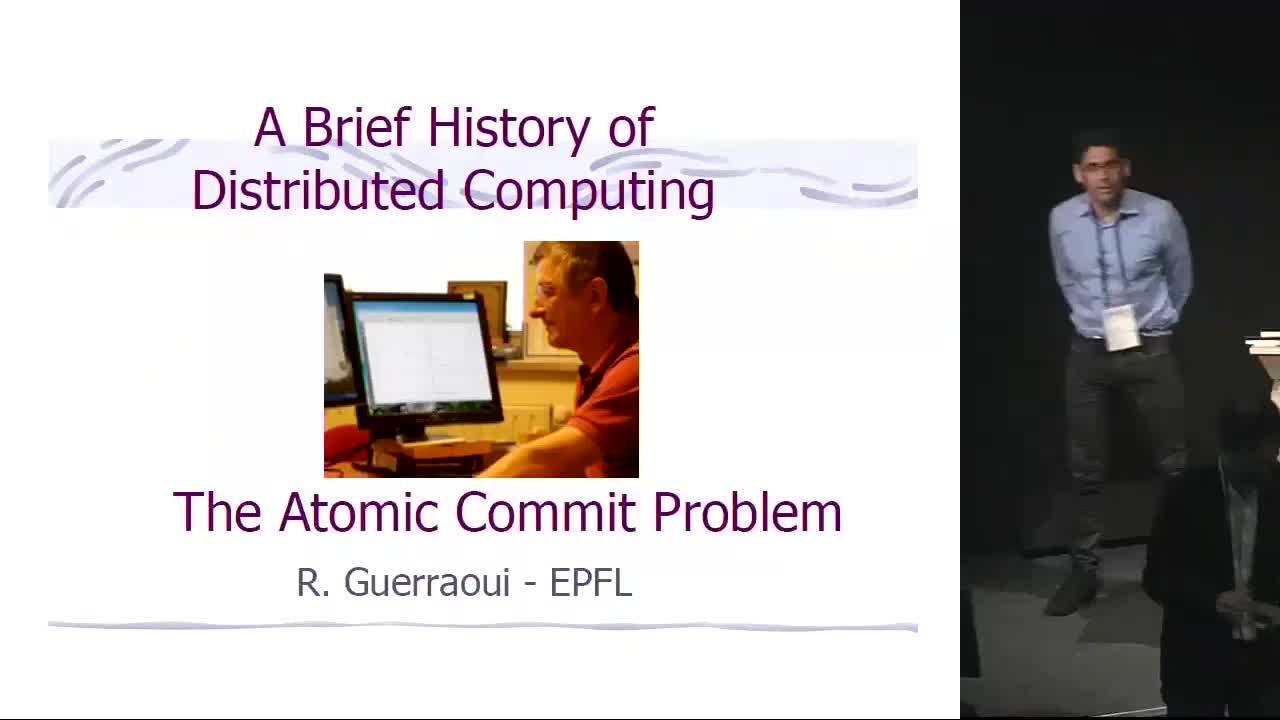
A brief history of atomic commitment
GuerraouiRachidCet exposé retrace brièvement l'historique de l'algorithmique répartie à travers l'un de ses problèmes les plus fondamentaux: la validation atomique.
-
Détecteurs de défaillance
Delporte-GalletCaroleCet exposé fait un tour d'horizon sur les détecteurs de défaillances, introduits par Chandra et Toueg en 1996. Michel Raynal a largement participé aux recherches sur ce sujet.
-
Adding Concurrency to Smart Contracts
HerlihyMauriceModern cryptocurrency systems, such as Ethereum, permit complex financial transactions through scripts called *smart contracts*. These smart contracts are executed many, many times, always without
-
The Bakery Algorithm in 2015
LamportLeslieThis talk revisits the Bakery Algorithm I proposed in 1974 from the point of view of the tools that we now have at our disposal in 2015, notably the PlusCal Algorithm Language, and the TLA+