Chapitres
- Introduction de Jan-Markus Vömel 03'17"
- Immersed in a Dream...06'33"
- Islamic Civilizationism in Turkey - Concepts and Functions14'42"
- Thinking about Turkey's place in the World 04'48"
- Birth of the Civilizational University 03'05"
- The "Civilizationist": Outline of a social figure05'15"
- Introduction d'Alihan Mestci 01'33"
- A socio-historical approach to "culture wars" 00'43"
- From polarization to public problem00'22"
- Corpus and method05'10"
- Why start in 2009?12'42"
- The temporal grammar of "cultural power"08'00"
- Officializing "cultural power": the Third Nation Culture Council (2017)08'45"
- How "cutlure wars" function in practice 03'55"
- Intervention de Ilker Aytürk et discussion27'20"
Notice

DÉCRIPT Séance 2 de l'axe Proche et Moyen-Orient : Resurrecting a Lost Civilization: Understanding "Culture Wars" and Islamic Civilizationism in Contemporary Turkey
- document 1 document 2 document 3
- niveau 1 niveau 2 niveau 3
Descriptif
From nostalgic horizon to political weapon, ‘civilization’ has become one of the key idioms through which power speaks in contemporary Turkey.
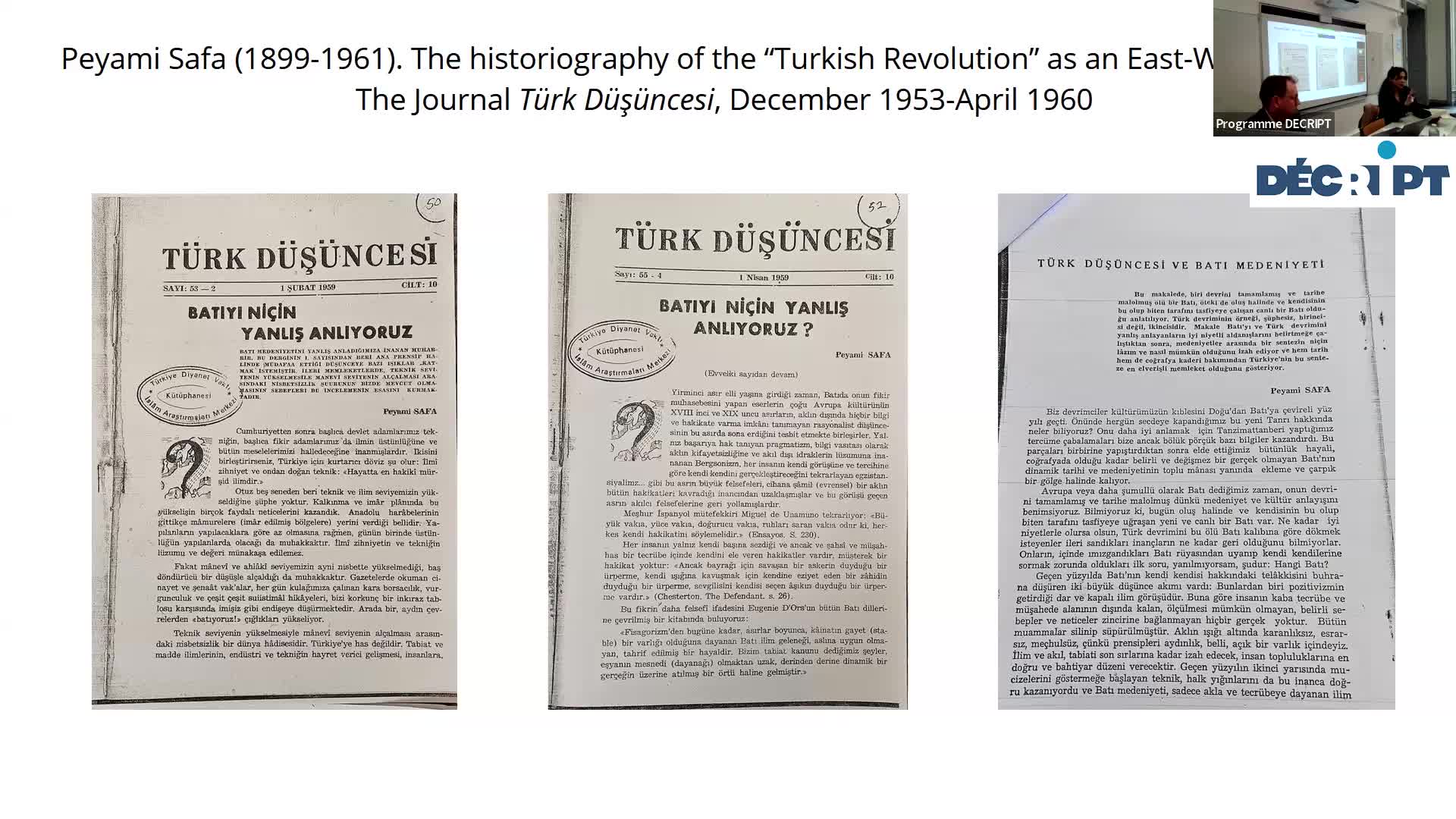
The first part of this talk will examine how civilizationism became a key element of the Turkish Islamist worldview while the movement was in opposition. Starting in the 1950s and gaining traction in the 1970s, civilizationism became a conceptual language of its own that mediated between the national framework and the wider world. From very early on, it was embedded in desires of resurrected imperial prowess, leadership, and prestige in the Muslim world, to which a civilizational reorientation would reconnect Turkey. Following the movement into government, the talk then traces the emergence of universities founded on explicit civilizational principles, and of a foreign policy laced with civilizational references, both born directly out of the earlier intellectual foundation. Finally, we will make the acquaintance of the unique social type of the civilizationalist intellectual-academic-politician that moves between these three fields.
The second part then examines how ‘culture wars’ that reframe domestic symbolic conflicts into broader civilizational narratives have become both a social phenomenon and a powerful interpretive framework in contemporary Turkey. It draws on a sociological analysis of conservative intellectuals and the cultural policies of the Erdoğan era. By reconstructing the sociogenesis of this category within the intellectual field, the study traces its translation into governmental practice. The analysis shows that ‘culture wars’ function as a mode of legitimation and a repertoire of state intervention. In doing so, it intersects with the rise of Islamic civilizationism, explored in this lecture series and the Decript program as a whole.
Intervention / Responsable scientifique
Thème
Avec les mêmes intervenants et intervenantes
-
Thinking and Performing « Civilization » in the Late Ottoman Empire and the Kemalist Republic
VömelJan-MarkusSzurekEmmanuelSarmisDilekDilek Sarmış, maîtresse de conférences, Université de Strasbourg, GEO, CETOBaC et Emmanuel Szurek, maître de conférences, EHESS, CETOBaC interviennent pour cette 4ème séance du séminaire de l'axe
-
DÉCRIPT Séance 3 de l'axe Proche et Moyen-Orient : "Civilisation" as a Concept of Power: Genealogie…
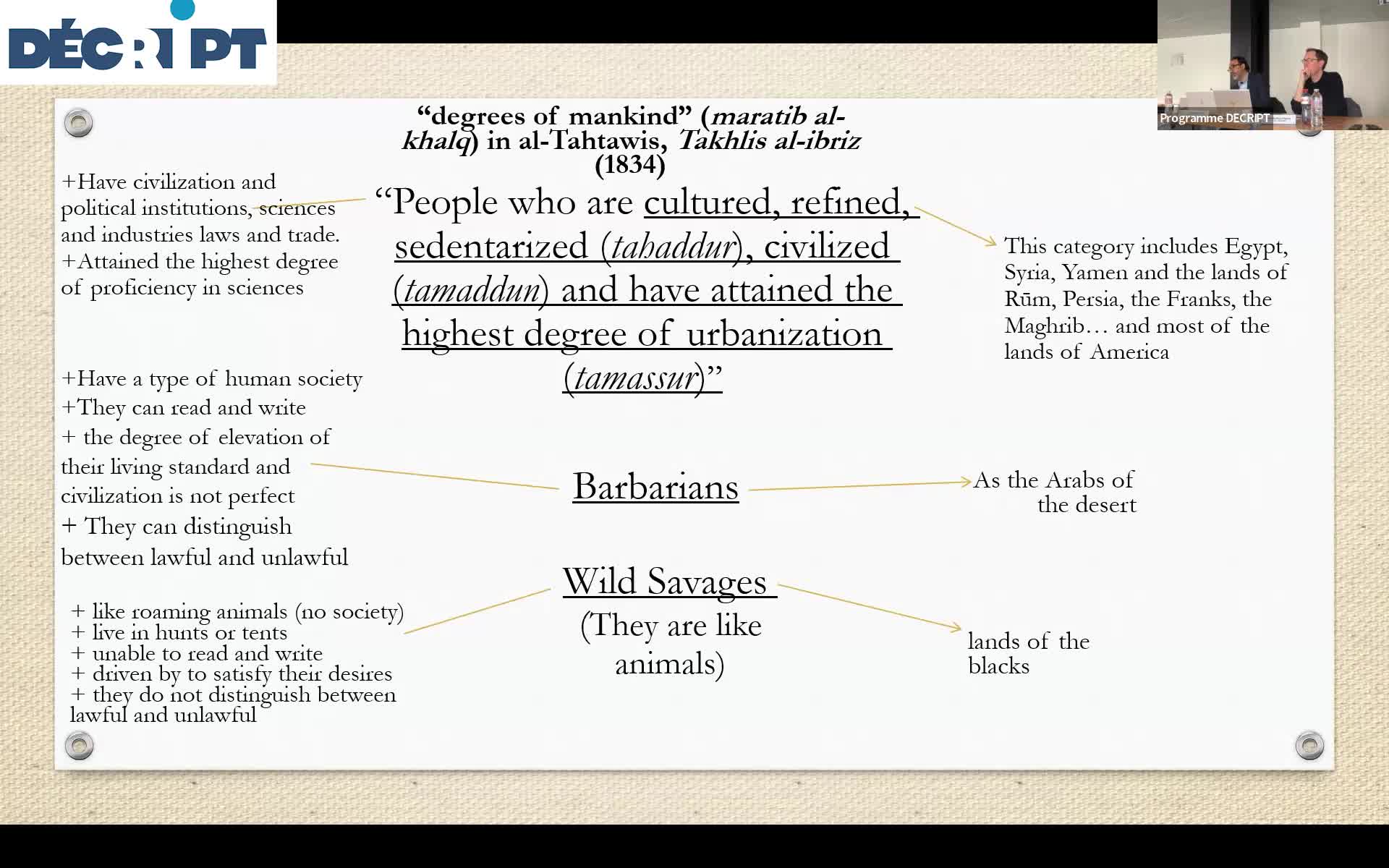
VömelJan-MarkusAbu-'UksaWaelWael Abu-'Uksa, Professeur en Science Politique à l'Université Hébraïque de Jérusalem présente ses travaux sur le la "civilisation" comme un concept de pouvoir.
Sur le même thème
-
Anthropocène : comprendre nos paysages transformés, avec Simon Dufour
DufourSimonNos paysages et nos rivières se transforment. Le géographe Simon Dufour explore l'anthropocène, cette nature devenue « hybridée », et interroge la place du chercheur face à ces bouleversements. Un
-
Café CoARA France | Les dérives de l’évaluation de la recherche : interventionnisme, réductionnisme…
Boukacem-ZeghmouriChérifaCette intervention interroge les dérives de l’évaluation de la recherche et analyse leur développement au fil du temps, à travers les phénomènes d’interventionnisme, de réductionnisme et d
-
"The Natural Way for the Machine" : Big Data and the Problem of Representation in large Data Models…
MoedingAmira"The Natural Way for the Machine" : Big Data and the Problem of Representation in large Data Models ca. 1950 – 2012
-
Maternités autorisées, maternités proscrites
CoulasMarjorieInterview de Marjorie Coulas, dans le cadre de la sortie de son ouvrage "Maternités autorisées, maternités proscrites"
-
Soirée de présentation de l'ouvrage "Maternités autorisées, maternités proscrites"
CoulasMarjorieMazauretteMaïaSoirée de présentation de l'ouvrage "Maternités autorisées, maternités proscrites" avec Marjorie Coulas et Maïa Mazaurette, qui s'est tenue le 28 mai au Grand Hall de la FMSH
-
Séminaire Humanités numériques de la MSHB - 2026
BergèreMarcPressacJean-BaptisteBenvegnú dos SantosAlineHessAurélieChoquetChloéLe séminaire Humanités numériques, porté par la plateforme Humanités numériques de la MSHB, en partenariat avec le CRBC et TEMOS revient en 2026. Cette journée d’étude est organisée dans le cadre des
-
Ciné-dialogues Afrique 2025-2026 – Séance 8/8 – L’Indomptable feu du printemps (2019) de Lemohang J…
BruzzoneAnnaMoseseLemohang JeremiahLe PoullennecAnnaelCiné-dialogues Afrique 2025-2026 – Séance 8/8 – L’Indomptable feu du printemps (2019) de Lemohang Jeremiah Mosese. Trialogue entre le réalisateur, Annael Le Poullennec et Anna Bruzzone.
-
Ciné-dialogues Afrique 2025-2026 – Séance 7/8 – Les Filles du Nil (2024) de Nada Riyadh et Ayman El…
BruzzoneAnnaEl AmirAymanCiné-dialogues Afrique 2025-2026 – Séance 7/8 – Les Filles du Nil (2024) de Nada Riyadh et Ayman El Amir. Dialogue entre Anna Bruzzone et Ayman El Amir
-
05 Utilisation et retours d'expériences d'outils numériques avec des élèves en situation de polyhan…
AndréCécileCécile André, enseignante spécialisée à l'EEAP « Quelque Chose en Plus »
-
03 Soutenir l’orientation et le développement des connaissances professionnelles grâce à un outil n…
EstivalSéverineExoPRO : Soutenir l’orientation et le développement des connaissances professionnelles grâce à un outil numérique inclusif.
-
01 Évaluer l’inclusivité d’un dispositif numérique dans l’éducation, approche pluridisciplinaire et…
BenoitHervéLouge DupratMagalieÉvaluer l’inclusivité d’un dispositif numérique dans l’éducation, approche pluridisciplinaire et systémique : un projet de recherche GTnum (DNE-MEN #EvalNumInclus) dans la chaire Unesco AUEN, dirigé
-
Catholicisme et hindouisme populaire à l’île de La Réunion, contacts, échanges.
GaudieuxAurélieRamsamy-GianconeCélineCatholicisme et hindouisme populaire à l’île de La Réunion, contacts, échanges.