Notice

What does and doesn’t do so do?
- document 1 document 2 document 3
- niveau 1 niveau 2 niveau 3
Descriptif
To test whether a given string after the verb is a complement or an adjunct, one can apply the well-known do so test, first mentioned by Lakoff and Johnson (1966) and a staple in generative grammar textbooks:
(1) a. *I remained in England and John did so in France.
b. John solved the problem in England and I did so in France. (Lakoff and Ross 1966: II-7)
In this presentation, I discuss the do-so test: how does it work, what are its limits, and what does it prove, if anything, about the inner constituent structure of a VP? More specifically, the following questions will be addressed:
1. Can the do so test be tweaked to function as a diagnostic for the constituency of an entire VP? It would be a pity if there were no real pro-form for an entire VP, including adjuncts.
2. Does the do so test work with all kinds of predicates? What about stative ones, negative ones, or passive ones? And if it does not work with stative ones, as Lakoff and Ross (1966: II-5) claimed, why then did their demonstration of the complement/adjunct contrast include such a verb, as shown above, in (1a)? Furthermore, what do we do with so-called ‘argumental to-phrases’ (cf. Miller 1990; 2014; Huddleston and Pullum 2002: 1533; McInnerney 2024)?
3. Does the do so test demonstrate that the verb forms a tighter unit – an inner syntactic constituent – with its complement(s) than it does with any adjunct, or are there grounds for considering complements and adjuncts as ‘sisters’ of the verb, sitting shoulder by shoulder in a ‘flat’ VP? With Culicover and Jackendoff (2005: 124–126), I argue for the latter option, based on rare but possible cases in which do so picks up a discontinuous string of a verb and a complement.
Communication de Bert CAPPELLE (Université de Lille, Savoirs, Textes, Langage UMR 8163)
Thème
Documentation
Dans la même collection
-
Les opérateurs to et -ing dans les suites verbales V1 V2 : approche méta-opérationnelle
GabilanJean-PierreDes verbes – appelés V1 – tels que begin, continue, forget, like, love, start, try, want etc. peuvent être aussi bien être suivis de to V2 que de V2-ing. Comment le choix est-il effectué ?
-
Transitivity and complements: investigating what it takes for a verb to be considered transitive
GardelleLaureThis talk investigates the category of “object” in relation to that of “complement.”
-
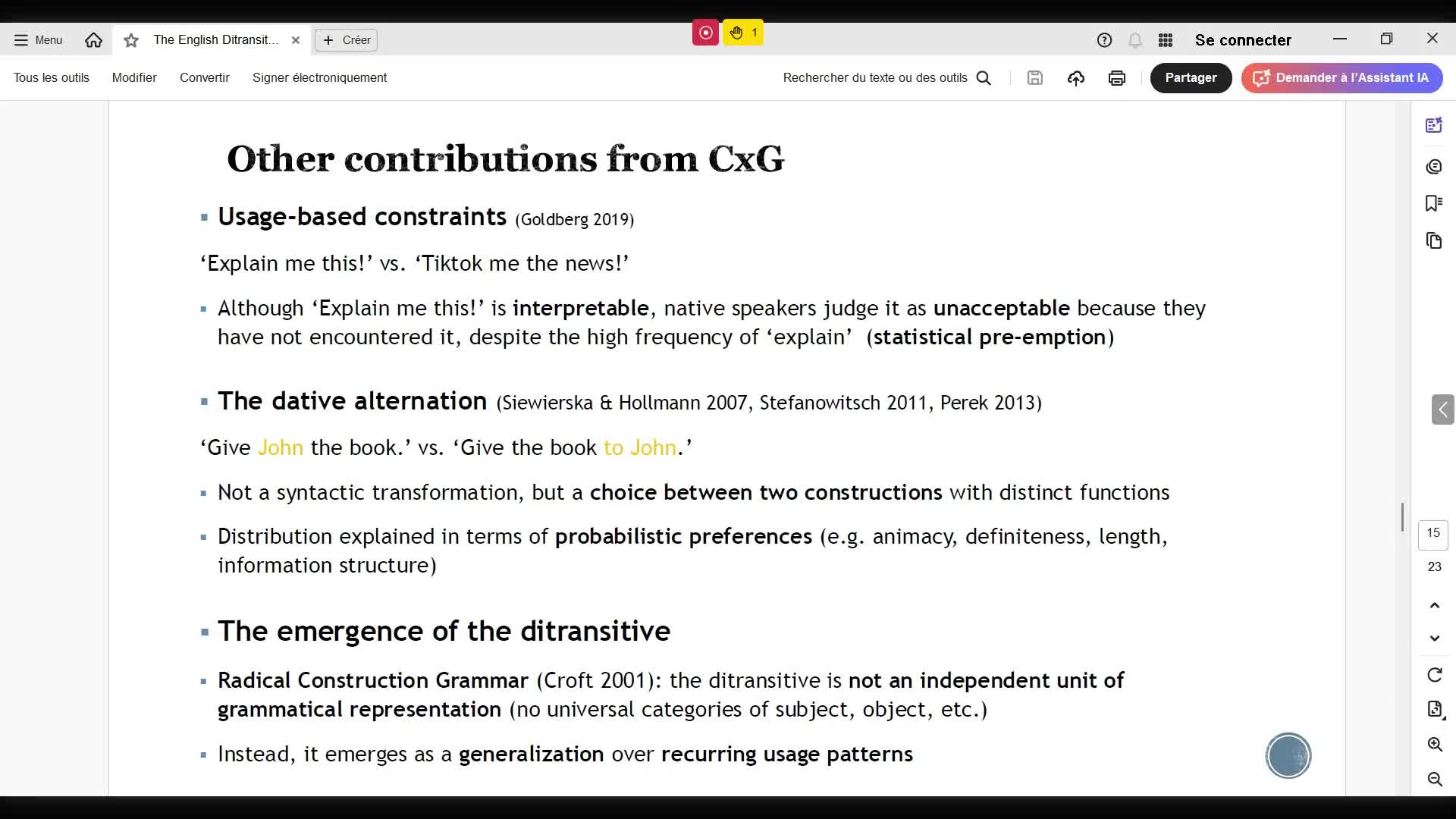
The English Ditransitive: Insights from Construction Grammar and its limits
MélacÉricConstruction Grammar (CxG) has had a significant impact on the analysis of the English ditransitive, as in She gave him a book.
-
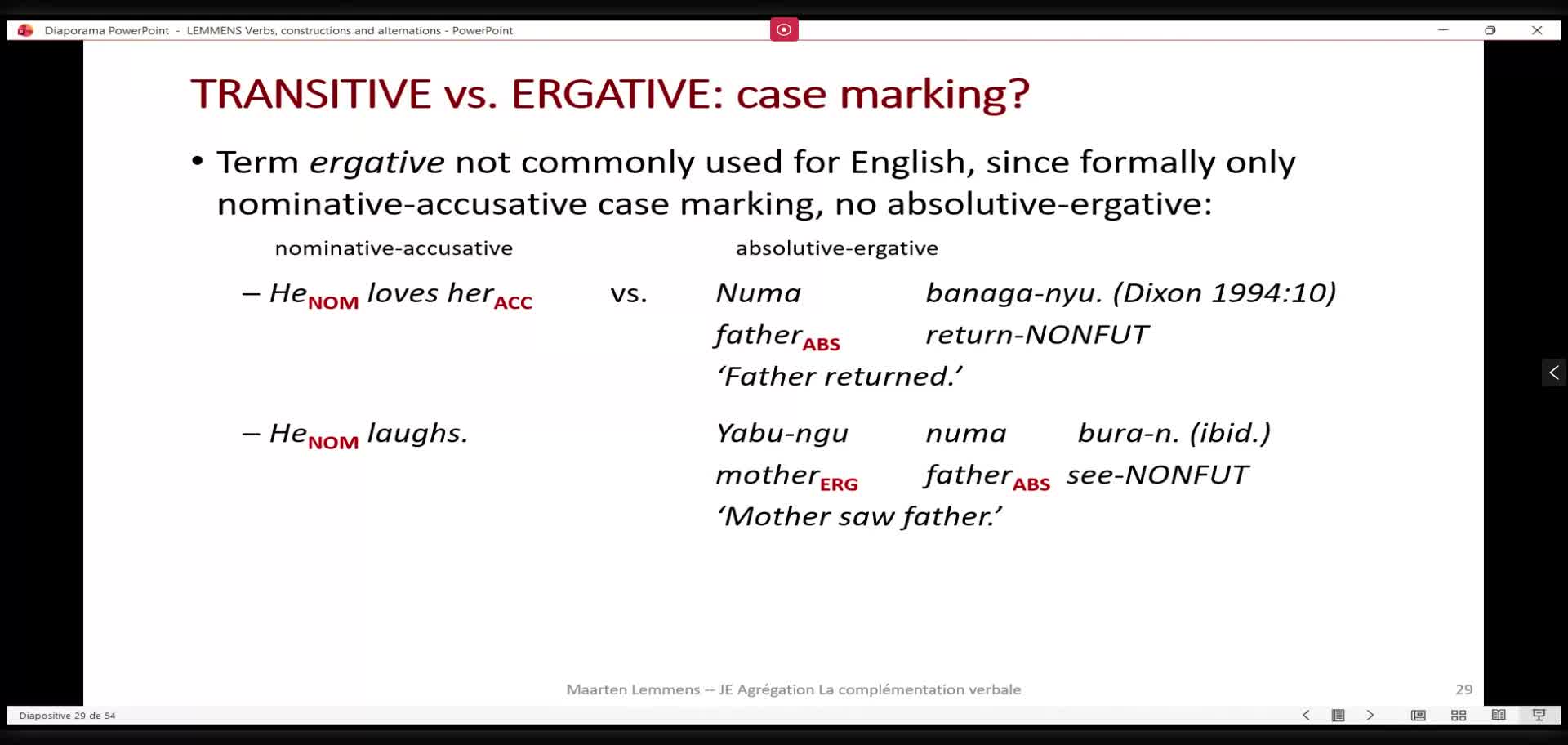
Verbs, constructions, and alternations
LemmensMaartenThis presentation gives a general description of a lexical-paradigmatic approach to alternations occurring with lexical causative verbs (like break, bounce, push or pull).
-
Valence et complémentation du verbe DO : repenser la projection des arguments sémantiques
OgerKimberlyCette communication propose une réflexion sur les notions de valence, de transitivité, d’argument et d’actant, à partir de l’étude du verbe lexical DO, souvent présenté comme le verbe d’action
-
Complements vs. Adjuncts; Arguments vs. Modifiers: an Overview
MillerPhilip H.In this talk, I provide an overview of the classical criteria claimed to distinguish complements and adjuncts and review some more recent work on the topic.
-
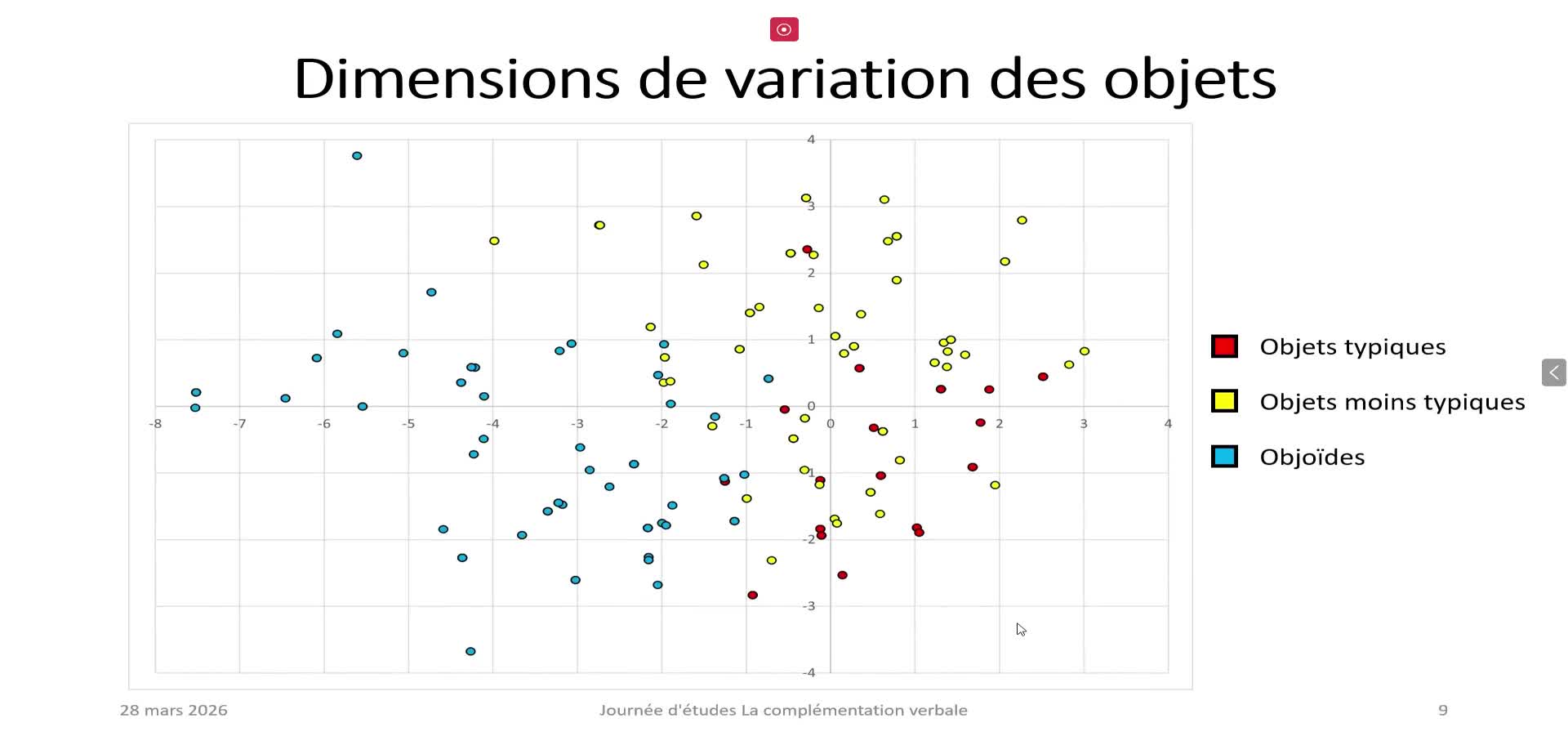
La diversité des objets en anglais
DelhemRomainLes différentes fonctions des dépendants du verbe peuvent être caractérisées comme des faisceaux de propriétés syntaxiques.