Notice

Video Interview of Yannick Mellier (2013)
- document 1 document 2 document 3
- niveau 1 niveau 2 niveau 3
Descriptif
Transcription:
[01:00:00:00 - 01:00:19:01]
My name is Yannick Mellier, I come from the Toulouse Observatory, where I actually completed my PhD, and then spent a few more years working
at the Toulouse Observatory. And I moved to the IAP in 1996,
[01:00:20:11 - 01:00:35:37]
mainly to work on a new field, namely gravitational distortion effects, on very, very large scales, in order to map the distribution of dark matter on cosmological scales.
[01:00:36:37 - 01:00:59:04]
To achieve this, it was necessary to develop new tools, including new statistical tools, not just data processing and analysis tools. It was also necessary to build a new team with both theoretical expertise, statistical, analytical, and observational skills, as well as data processing
and interpretation.
[01:01:00:10 - 01:01:30:33]
And here, I actually found everything I needed, by building a team, that allowed me to work on all fronts, and to set up the TERAPIX
data processing center, which subsequently became responsible for data analysis, the initial processing of images, focused on gravitational shear
on cosmological scales. We obtained our first results at the end of 1999
[01:01:32:11 - 01:02:13:07]
and this work continued, extending the analyses through 2003–2004. Then, following that, we extended this work to prepare a new space mission, allowing us to map phenomena that are even more subtle and difficult, which cannot be measured from the ground, and which ultimately enabled us
to build and to set up the Euclid space mission, which is now what occupies most of my time. It is a space mission, and space missions are always
difficult to put together, technically, operationally, and scientifically.
[01:02:14:23 - 01:02:18:34]
It is nevertheless a mission that will observe the sky for six years,
[01:02:19:42 - 01:02:34:01]
whose construction is beginning and which will be launched in 2020. So you see, 2020 plus sixyears of observation, that brings us to 2026. If you take into account the analysis and interpretation of the data, we are approaching the 2030s.
[01:02:35:03 - 01:03:32:15]
So you can see that this will keep me busy for quite a number of years. And since it is a space mission, and involves roughly
1,000 people, 1,000 scientists and engineers within the consortium, you can see that it is a large mission to manage, one that is extremely demanding
in all respects, including the management aspects of the entire group of people working on this project. When I came to the IAP in 1996, I truly had a scientific project in mind. I believed that the IAP, through its position, through its teams, but also through its central location
in Paris and the Île-de-France region, was a major asset for building large-scale and highly challenging scientific projects. I think that the past and the present show us that indeed, it was a good choice and I am very happy with it.
Thème
Avec les mêmes intervenants et intervenantes
-
Interview en vidéo de Yannick Mellier (2013)
MellierYannickInterview en vidéo de Yannick Mellier (1958-2025), dans son bureau à l'IAP, le 8 août 2025, par Jean Mouette (IAP). Yannick Mellier évoque sa carrière à l'IAP, les conditions de son arrivée et la
-
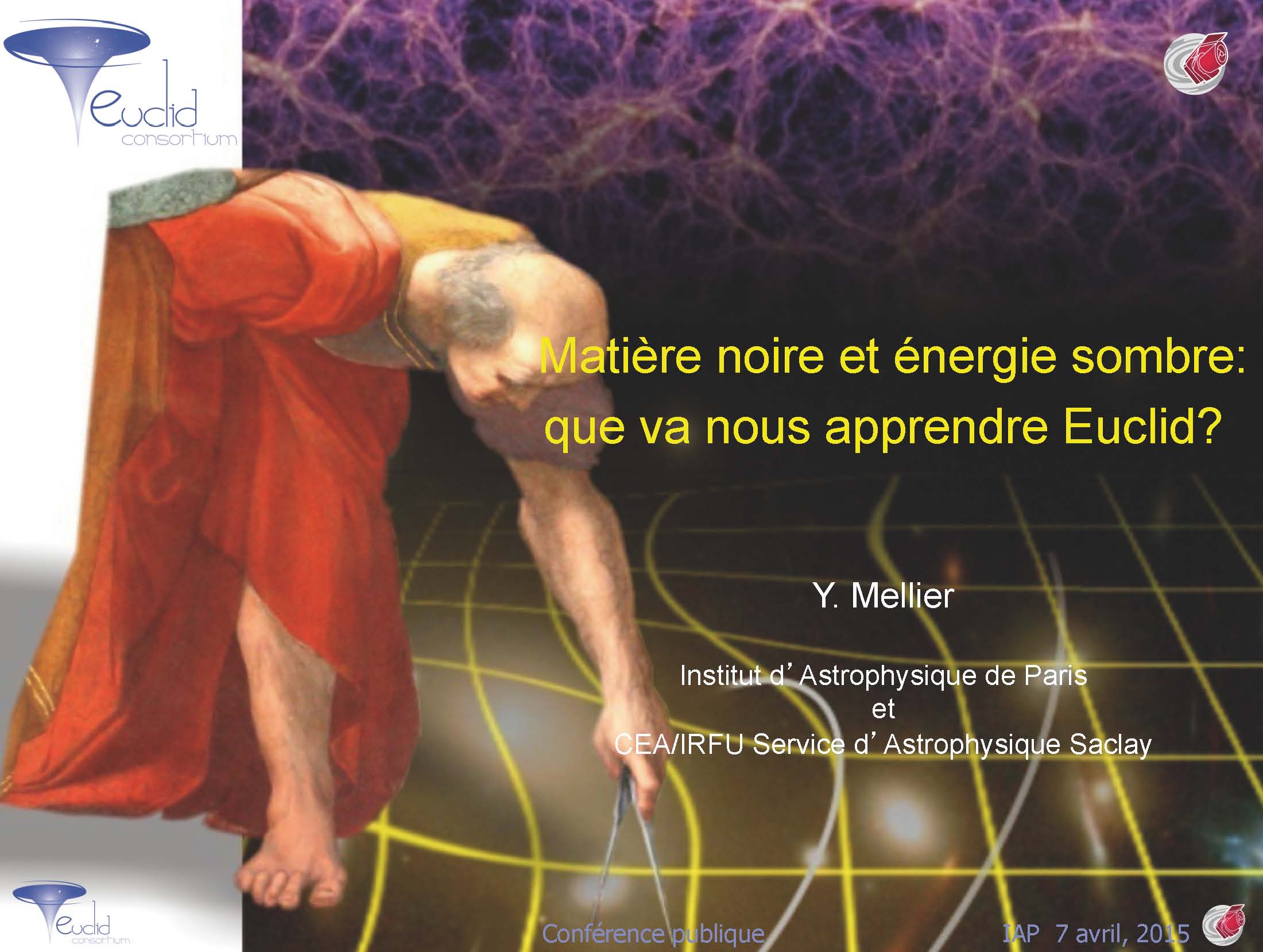
Matière noire et énergie sombre : que va nous apprendre Euclid ?
MellierYannickLa découverte de l'accélération de l'expansion de l'Univers conduit les cosmologistes à postuler l'existence d'une énergie noire qui serait la composante dominante du contenu en matière-énergie de l