


- document 1 document 2 document 3
- niveau 1 niveau 2 niveau 3
Descriptif
Moderator : Prof. Nathalie Champroux (Cultural and Discursive Interactions (ICD) / University of Tours - FR)
Dr Antonio Pele (Pontifical Catholic University of Rio de Janeiro - BR) - Brazil in Times Of Covid-19: Right to Health, 'Bioresistances' and Solidarities
I will first examine medical/health initiatives that favelas grassroots networks have taken to respond to the current pandemic. I will show how favela inhabitants have organized their system of information, ambulances, isolation wards, despite the lack of funding/support of local/national public authorities. Human rights and favelas activists often claim Sobrevivênica é Resistencia, that is, ‘survival is resistance’. I contend those health/medical networks of solidarity in times of COVID-19 intend to give back a worthy life to those who have not been granted the right to live with dignity in Brazil. In relation to those cases, I argue health becomes eminently political and closely related to social justice in Brazil. I will then explore the different strategies of ‘food sovereignty.’ I will examine how grassroots efforts intend to provide free organic foods and promote local farmer’s products/production in the favelas during the COVID-19 pandemic. I will contend they succeed in tackling the lack of Brazil public policy for healthy food consumption/production. I will also argue they innovatively tie a bio-form of resistance with the right to health. Indeed, with leveraging green spaces and community organizing in the favelas, the right to health becomes intersubjective. It is not reframed (anymore) on single individual entitlement but a collective experience based on solidarity.
Prof. Simon Springer (University of Newcastle - AU) - Mutual Aid and the Neoliberal Pandemic: Caring for Community during COVID and the Continuing Crisis of Capitalism
Neoliberalism is synonymous with crisis.With each successive natural or human made disaster we see the reach ofneoliberalism extended even further. These moments of vulnerability areexploited as opportunities to push through unpopular changes when people aretoo bewildered and beleaguered to fight back. The recent COVID-19 pandemic isexemplary of this ongoing logic, insofar as it has been the rationale for manysectors, most notably higher education, to “rationalize” and “optimize” theiroperations more and more along market lines. The idea of education for the sakeof knowledge production and personal growth no longer holds true. Governmentsare putting pressure on the sector to create “job ready graduates”, which meanspandering to a consumerist ethos and speculating on industry demands. Mass jobcuts follow such restructuring and communities, already devastated by a crisis,face new hardships that work against the shared interest of recovery. But thereis an alternative to this callous trajectory and it is to be found in mutualaid and community based forms of reciprocity. Mutual aid is the fundamentalbasis of all human societies, an understanding that, in sharp relief toneoliberalism, is also exemplified with striking clarity during times ofcrises. People necessarily come together and help each other out in thesemoments. So as neoliberalism rushes in to capitalize on catastrophe, itsfailings are simultaneously exposed by the ingenuity and resourcefulness ofcommunities who, in spite of the challenges, almost always find a way torebuild their lives through practices of caring for community.
Notice
Conférence GENA
|
Conférence
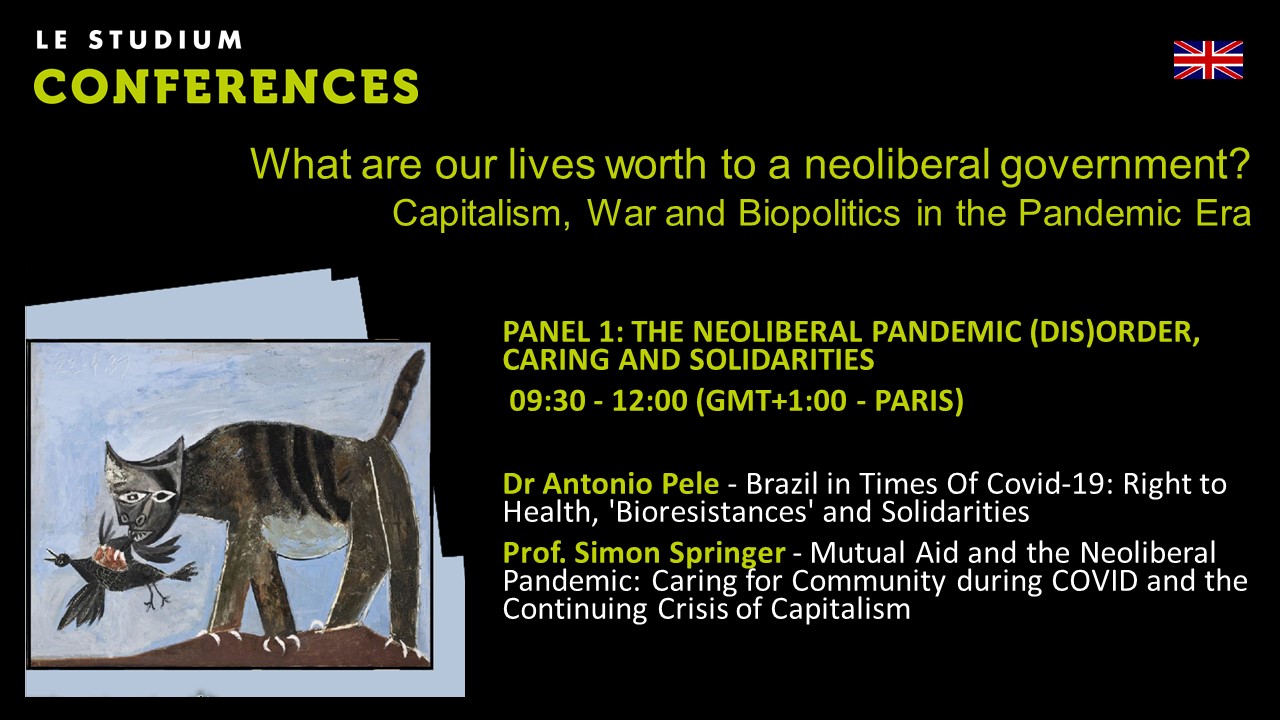
PANEL 1: THE NEOLIBERAL PANDEMIC (DIS)ORDER, CARING AND SOLIDARITIES
Moderator : Prof. Nathalie Champroux (Cultural and Discursive Interactions (ICD) / University of Tours - FR) Dr Antonio Pele (Pontifical Catholic University of Rio de Janeiro - BR) - Brazil in Times Of Covid-19: Right to Health, 'Bioresistances' and Solidarities I will first examine medical/health initiatives that favelas grassroots networks have taken to respond to the current pandemic. I will show how favela inhabitants have organized their system of information, ambulances, isolation wards, despite the lack of funding/support of local/national public authorities. Human rights and favelas activists often claim Sobrevivênica é Resistencia, that is, ‘survival is resistance’. I contend those health/medical networks of solidarity in times of COVID-19 intend to give back a worthy life to those who have not been granted the right to live w
02:22:40
|
Débuter à: 00:00:00 |
|
Conférence
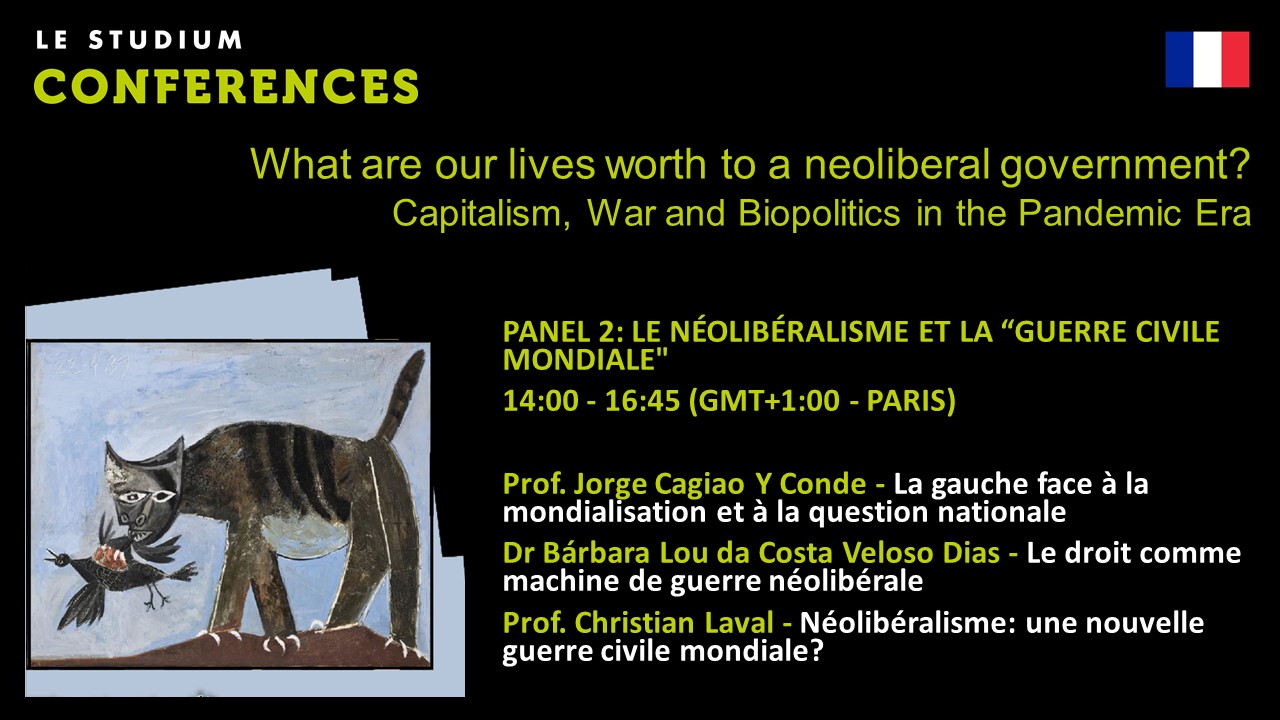
PANEL 2: LE NÉOLIBÉRALISME ET LA “GUERRE CIVILE MONDIALE"
Moderator: Prof. Elisabeth Gavoille (Cultural and Discursive Interactions (ICD) / University of Tours - FR) Prof. Jorge Cagiao Y Conde (Cultural and Discursive Interactions (ICD) / University of Tours – FR) - La gauche face à la mondialisation et à la question nationale Je m’intéresse dans ma contribution à la relation complexe que la gauche entretient avec la mondialisation et le nationalisme. D’une part, son adhésion à un projet de dépassement du cadre stato-national pour la démocratie, bien que nuancée, semble aujourd’hui acquise. L’UE en serait la meilleure illustration dans l’espace européen. Les résistances à ce projet sont par ailleurs dénoncées en raison du nationalisme (perçu systématiquement comme un danger pour la démocratie) dont elles seraient le reflet. Un nationalisme à l’égard duquel la gauche a traditionnellement
02:38:27
|
Débuter à: 00:00:00 |
|
Conférence
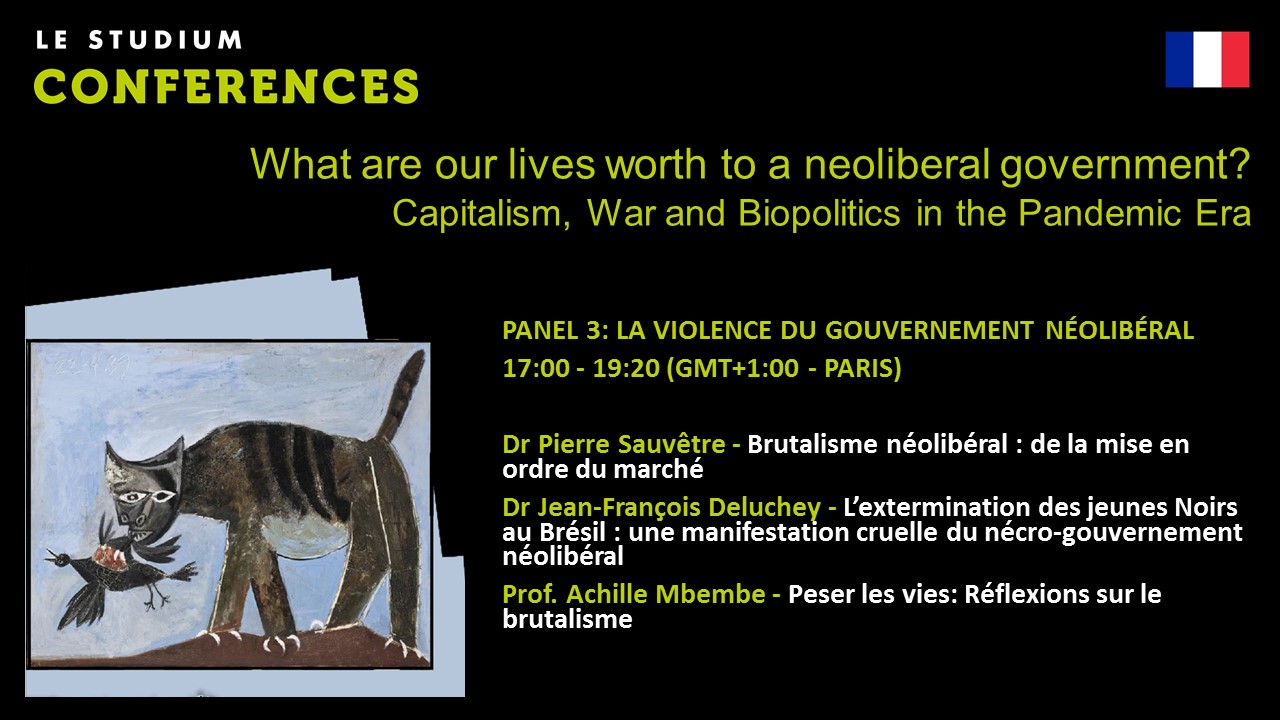
PANEL 3: LA VIOLENCE DU GOUVERNEMENT NÉOLIBÉRAL
Moderator: Dr. Maboula Soumahoro (Cultural and Discursive Interactions (ICD) / University of Tours - FR) Dr Pierre Sauvêtre (Sophiapol / GENA, Paris-Nanterre University - FR) - Brutalisme néolibéral : de la mise en ordre du marché Notre présentation essaiera de caractériser le néolibéralisme comme un brutalisme concurrentiel, au sens où ce à quoi consiste concrètement la rationalité gouvernementale est l’imposition par l’État, et en dernière analyse par la violence d’État, d’un ordre national et global, de la concurrence économique. Tout en partageant de nombreux aspects de l’analyse de Foucault, en particulier l’idée que le néolibéralisme se distingue du libéralisme par le fait qu’il soumet le marché à la norme de la concurrence, on s’éloignera de la définition de la gouvernementalité néolibérale comme d’un pouvoir consistant d
02:34:41
|
Débuter à: 00:00:00 |
|
Conférence
PANEL 4: LA VALEUR NÉOLIBÉRALE DE L’HUMAIN
Moderator: Prof. Juliette Grange (Cultural and Discursive Interactions (ICD) / University of Tours - FR) Dr Alfredo Gomez-Muller (Cultural and Discursive Interactions (ICD) / University of Tours – FR) - Valeur humaine et valeur marchande dans le débat sur le « bon gouvernement » des Incas, au siècle des Lumières en France Au XVIIIe siècle les récits sur le « bon gouvernement » des Incas deviennent un référent culturel important qui va contribuer au renouveau de la pensée politique en Europe. Ces récits donnent lieu à une « controverse » implicite dans laquelle la valorisation ou la dévalorisation du modèle général de justice distributive des Incas est corrélative à la compréhension de l’humain comme valeur ou comme non-valeur subordonnée à la valeur marchande. Se rattachant pour l’essentiel à la matrice narrative élaborée à la
02:36:44
|
Débuter à: 00:00:00 |
|
Conférence
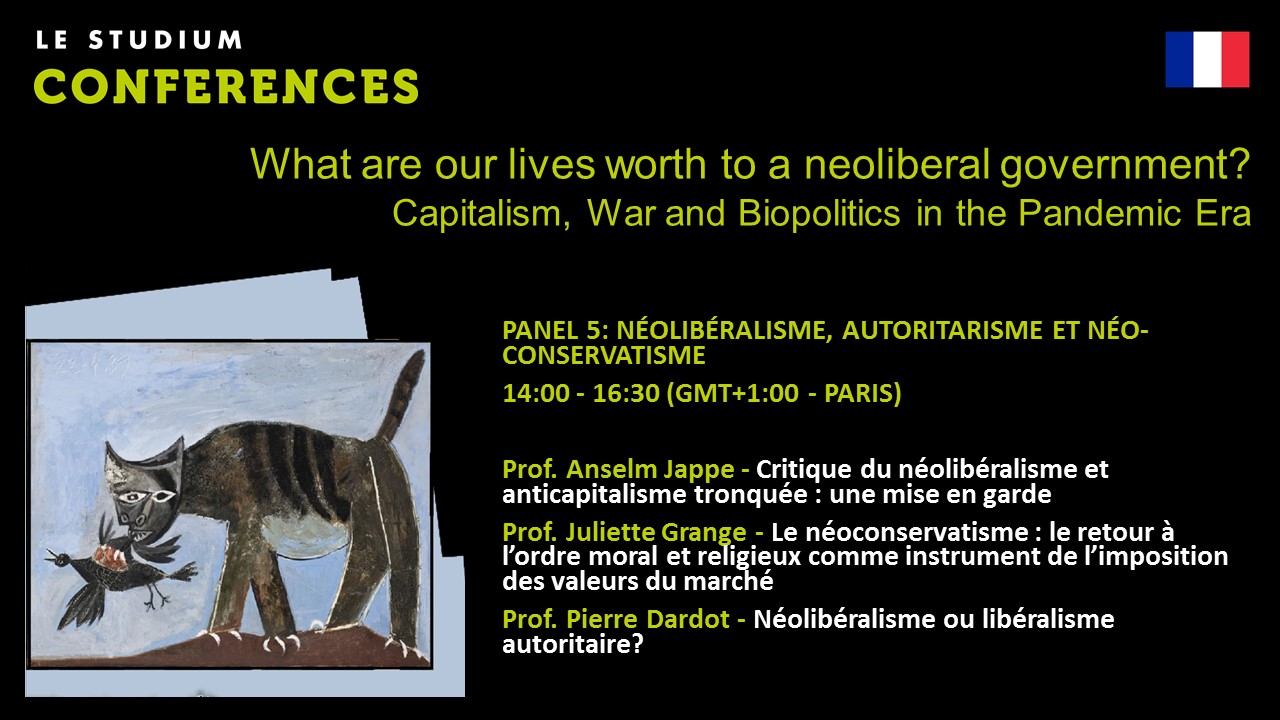
PANEL 5: NÉOLIBÉRALISME, AUTORITARISME ET NÉO-CONSERVATISME
Moderator: Dr Jean-François Deluchey (Cultural and Discursive Interactions (ICD) / University of Tours - FR and Federal University of Pará - BR)
02:26:57
|
Débuter à: 00:00:00 |
|
Conférence
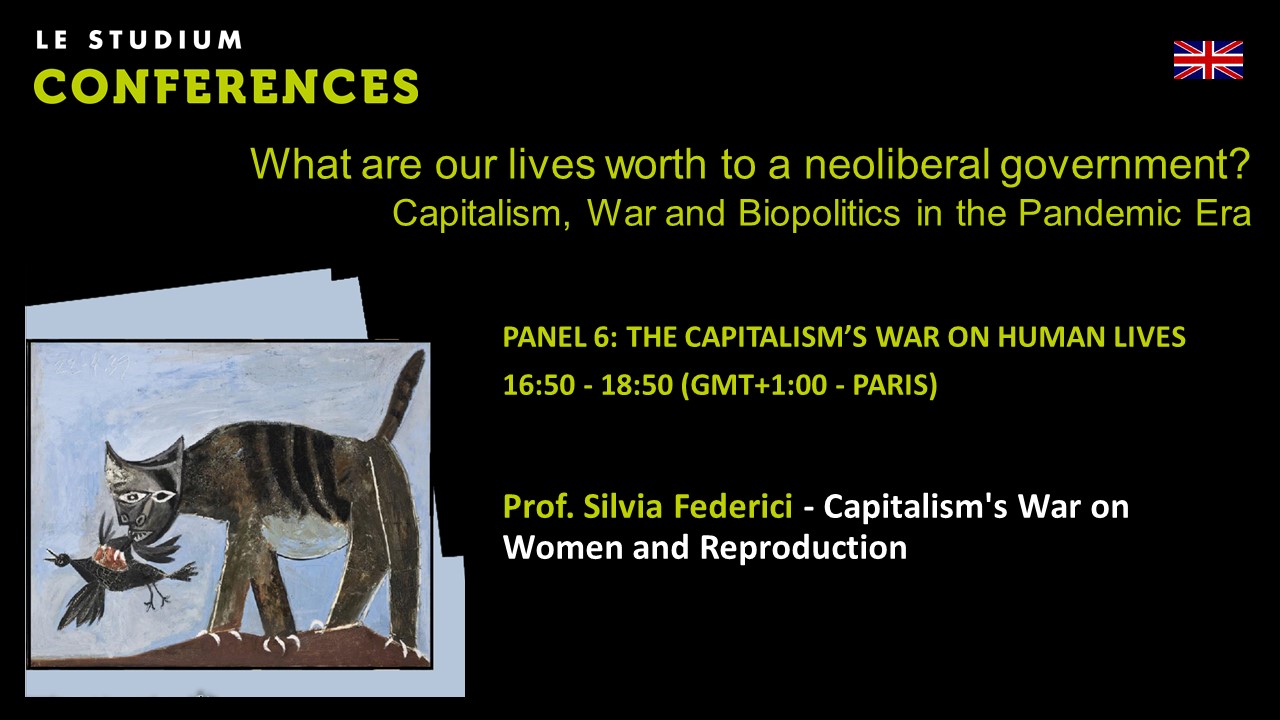
Panel 6: the capitalism's war on human lives
For Silvia Federici, the various forms assumed by neoliberal capitalist globalization compose a frontal attack on the reproductive labor force and the power of women.
02:00:35
|
Débuter à: 00:00:00 |