Notice

FOUNDS Seminar Series Talk 06 - Computation of the Rate-Distortion-Perception Function
- document 1 document 2 document 3
- niveau 1 niveau 2 niveau 3
Descriptif
Talk Abstract: In this talk, we study methods for the computation of a generalization of the rate-distortion function called the rate-distortion-perception function (RDPF). This generalization to the rate-distortion problem was defined by the computer vision and machine learning community in recent years, to give a mathematical interpretation to the observation that “low distortion” is not a synonym for “high perceptual quality”, and, from an optimization perspective, there is a tradeoff between the distortion and the perception. The RDPF is also a relevant semantic-based metric in compression. For discrete sources, with single-letter distortion and a perception constraint that belongs to the family of f-divergences, we compute the RDPF by proposing an approximate alternating minimization approach a la Blahut-Arimoto algorithm that converges to a globally optimal point. For scalar Gaussian sources with squared error distortion and a perception constraint that can be either the KL divergence, the squared Wasserstein distance, the squared Hellinger distance, or the geometric Jensen-Shannon divergence, we derive closed-form expressions under the assumption of jointly Gaussian processes. Our closed-form solutions are also supported by their corresponding test-channel forward realizations, the first of their kind. For vector Gaussian sources, we propose a generic alternating minimization algorithm using a block-coordinated descent method that can optimally compute the vector Gaussian RDPF. For the extreme case of the perfect-realism vector Gaussian RDPF, that is to say, when the Gaussian distribution of the source and the reconstruction are constrained to be the same, we derive in closed-form solution a new optimal adaptive reverse-water- filling solution. We corroborate our findings with various simulation studies.
Intervention / Responsable scientifique
Thème
Documentation
Sur le même thème
-
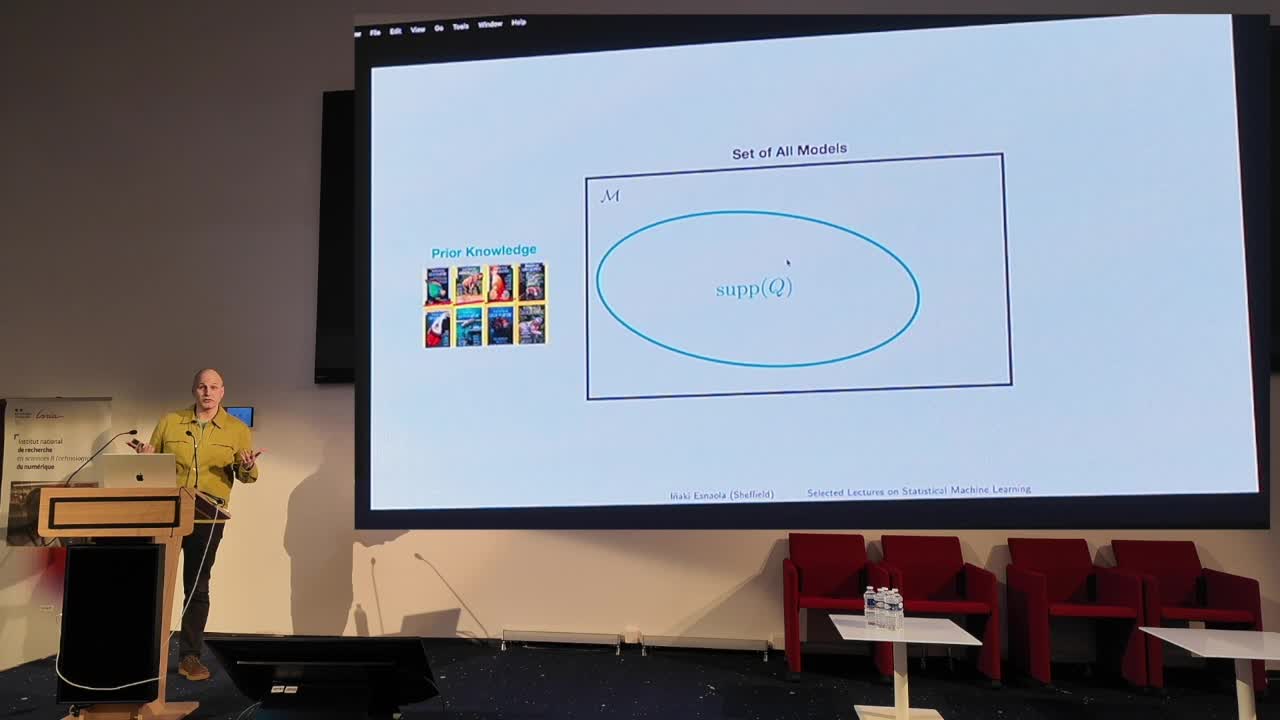
Machine Learning Regularization via Information Measures
Iñaki EsnaolaL’effet de l’asymétrie de l’entropie relative est analysé dans le contexte de la minimisation du risque empirique (ERM) avec régularisation par entropie relative (ERM-RER).
-
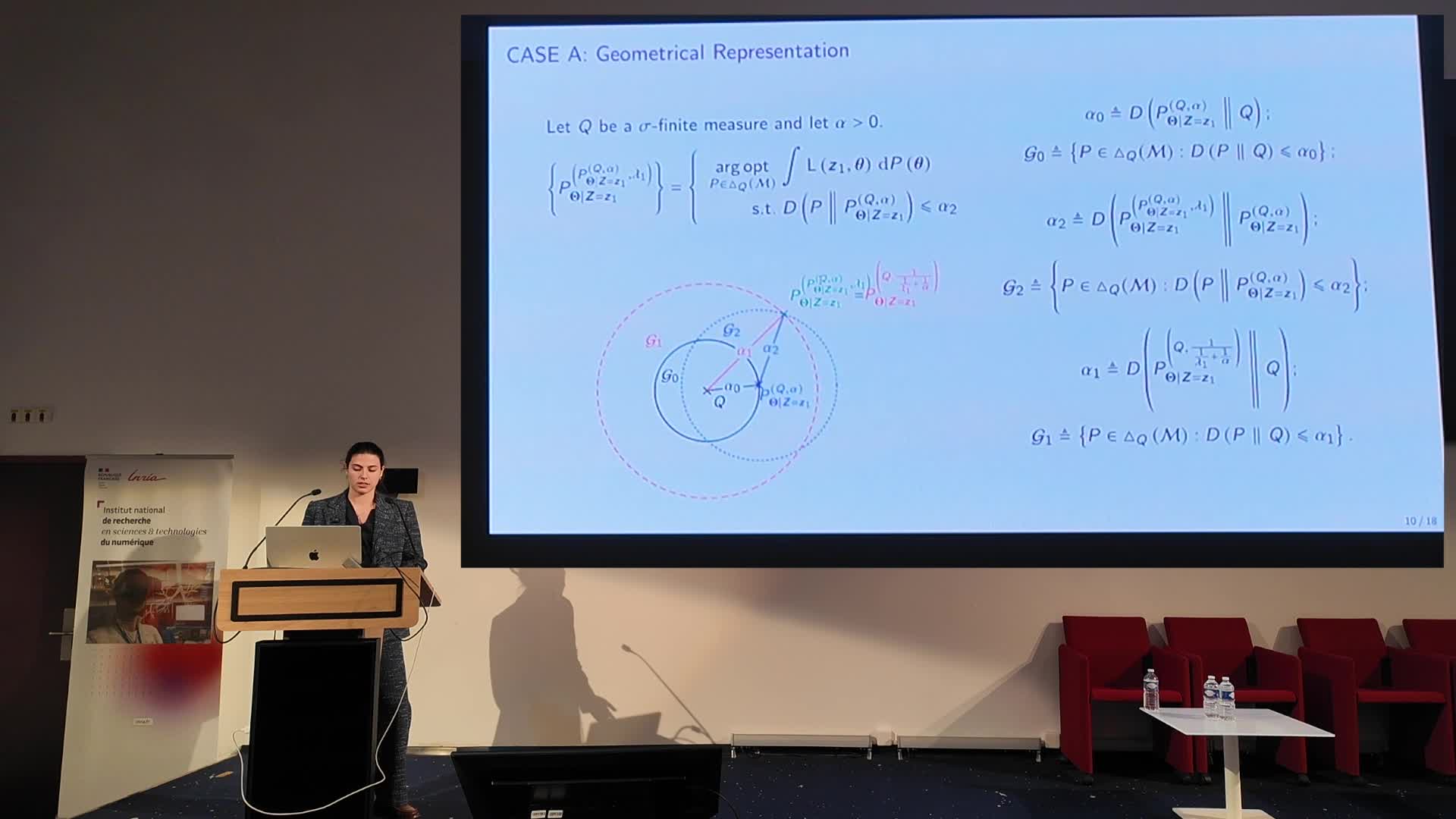
Minimization and Maximization of Empirical Risks: Applications in Data Unlearning and Decentralized…
BermudezYaizaCette présentation propose une nouvelle perspective sur la minimisation et la maximisation des risques empiriques avec régularisation par entropie relative en apprentissage statistique.
-
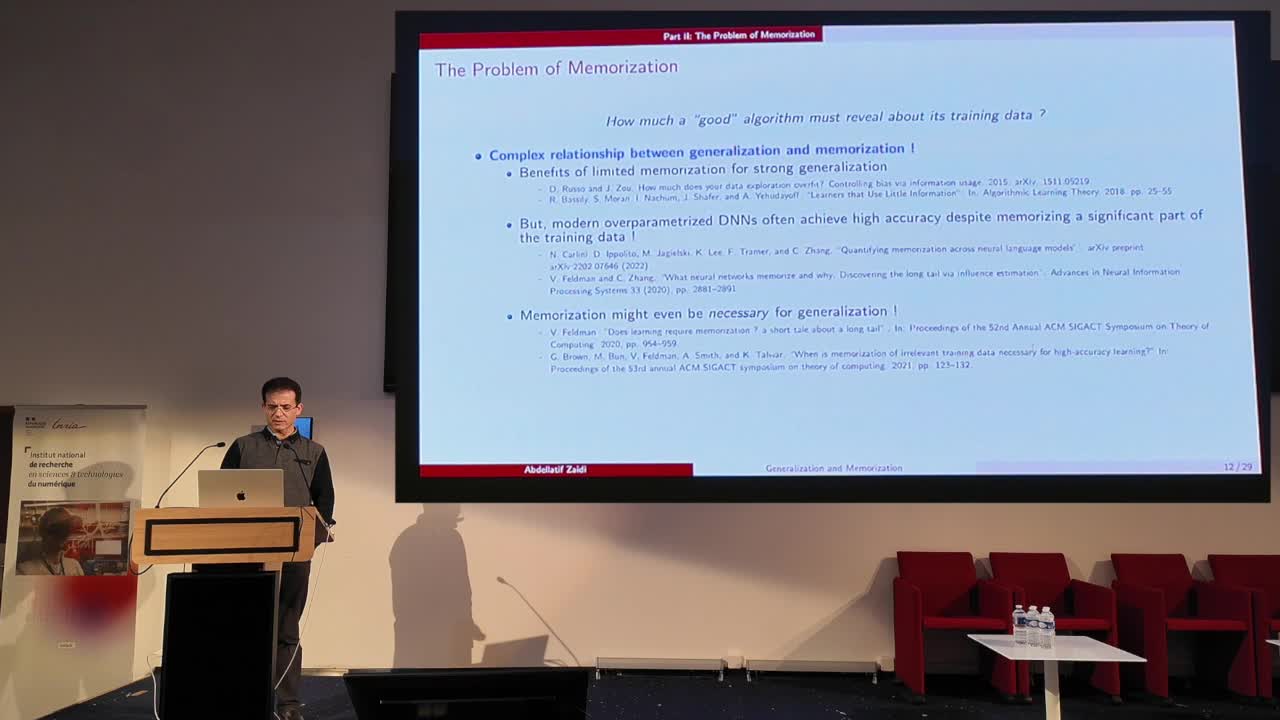
A Compressibility Approach to Generalization and (No) Memorization
ZaidiAbdellatifUne conférence sur l’approche par la compressibilité pour comprendre la généralisation et la non-mémorisation.
-
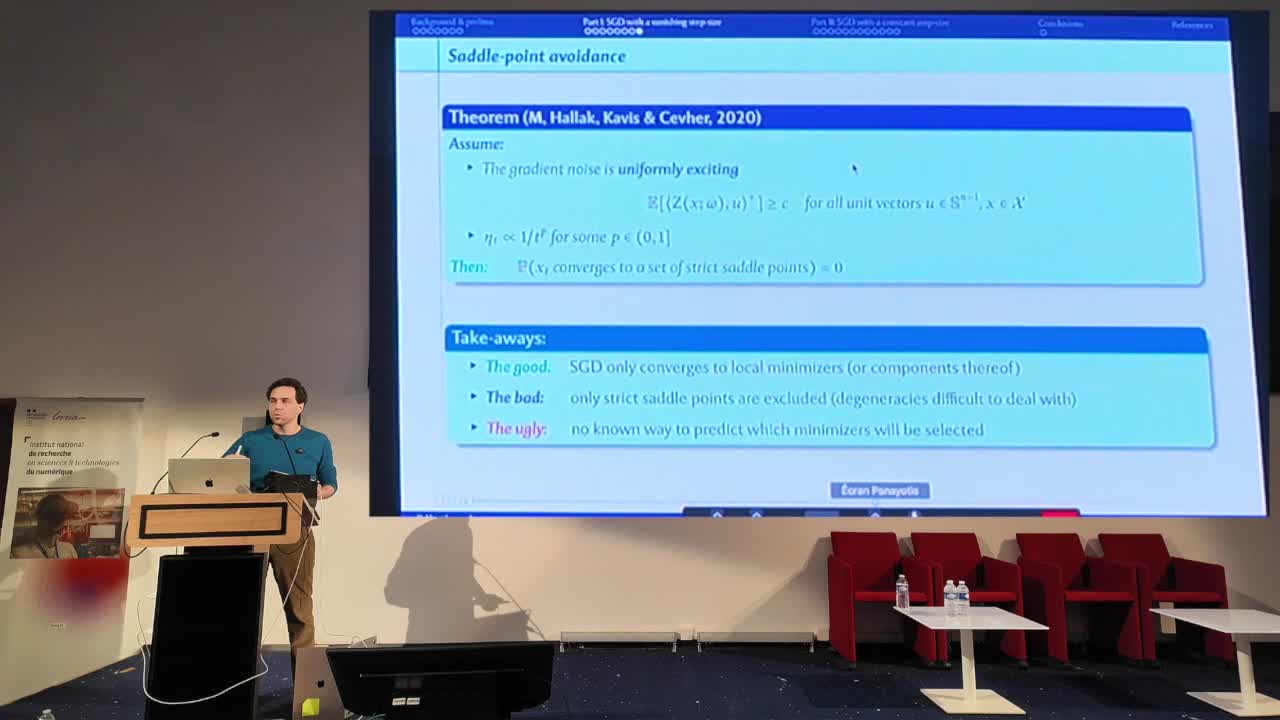
What is the Long-Run Distribution of Stochastic Gradient Descent?
MertikopoulosPanayotisCette conférence explique le comportement à long terme de la descente de gradient stochastique, en montrant qu’elle tend à se concentrer autour des points critiques de basse énergie d’une manière
-
Rethinking Generalisation: Beyond KL with Geometry and Comparators
GuedjBenjaminIntervention sur la généralisation en apprentissage automatique, les avancées récentes de la théorie PAC-bayésienne, l’usage des distances de Wasserstein, les cadres généraux de comparateurs, ainsi
-
FOUNDS Seminar Series Talk 12 - Decision making via End-to-End Lossy Distributed Wireless Networks
Talk Title : Decision making via End-to-End Lossy Distributed Wireless Networks: A Distributed Hypothesis Testing based Formulation Abstract : The goal of this seminar is to provide the
-
FOUNDS Seminar Series Talk 11 - Stochastic Geometry and Queuing Dynamics
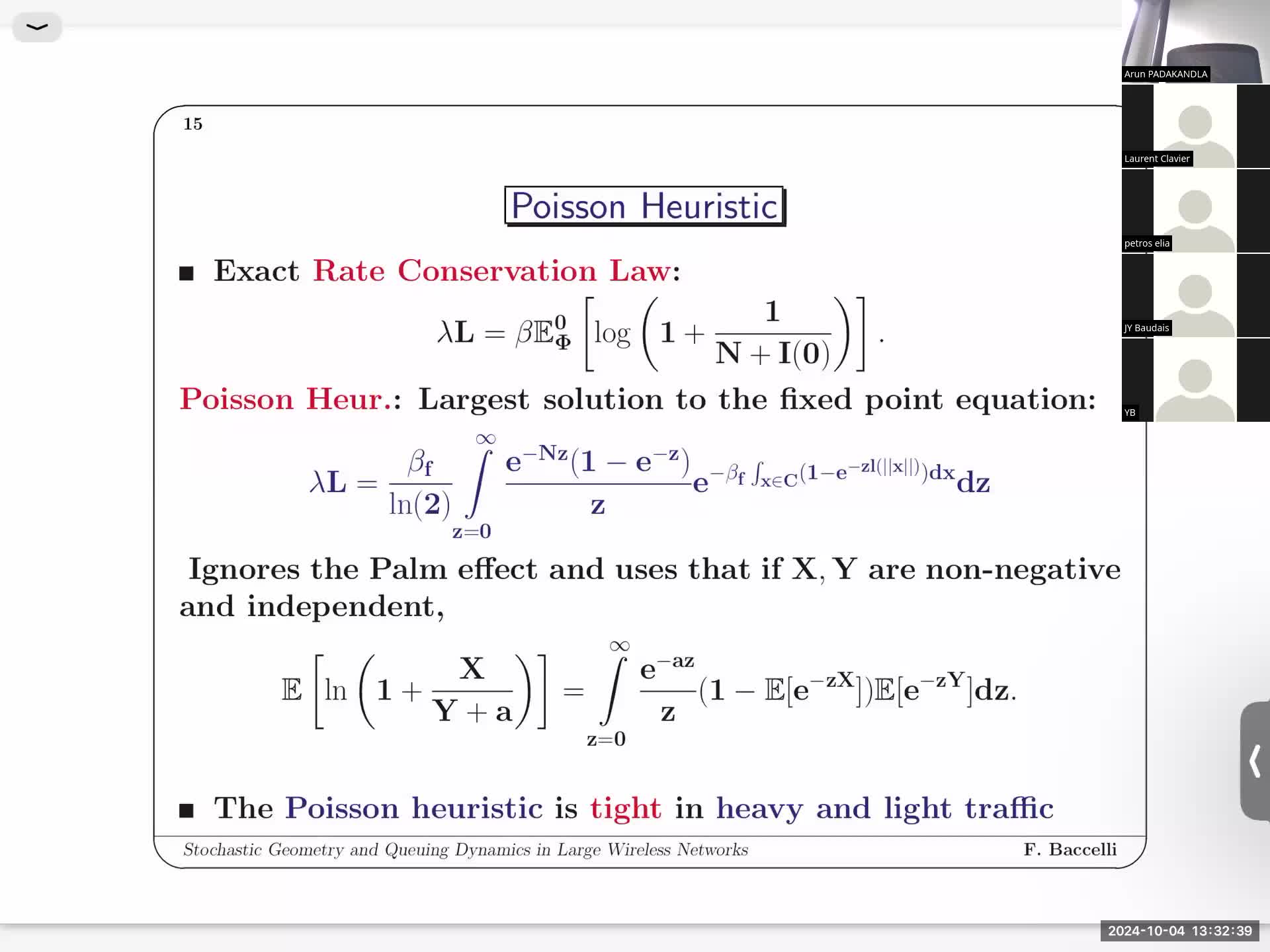
BaccelliFrançoisSeminar Title : Stochastic Geometry and Queuing Dynamics in Large Wireless Networks
-
FOUNDS SEMINAR SERIES TALK 10 - Distributed Binary Hypothesis Testing
SarkissMireilleTitle: Distributed Binary Hypothesis Testing Abstract: Distributed binary hypothesis testing (DHT) problem has many applications in IoT and future networks such as distributed decision and
-
FOUNDS SEMINAR SERIES TALK 09 - Spatial Network Calculus and Performance Guarantees in Wireless Net…
FengKeTitle : Spatial Network Calculus and Performance Guarantees in Wireless Networks Abstract : Network calculus is a methodology allowing one to provide performance guarantees in queuing networks
-
FOUNDS SEMINAR SERIES TALK 08 - Information Theoretic Converses via Change of Measure
WiggerMichèleTitle : Information-Theoretic Proofs based on Change of Measure Arguments Abstract : We will be presenting information-theoretic proofs based on change of measure arguments for basic source coding
-
FOUNDS Seminar Series Talk 07 - Communication Models for Intelligent Metasurfaces Using Multiport N…
Di RenzoMarcoIntelligent metasurfaces are an emerging technology that enhances the reliability of data transmission by appropriately shaping the propagation of electromagnetic waves in the wave domain, by turning
-
FOUNDS Seminar Series Talk 04 - Distributed Computation over Networks
MalakDeryaDistributed Computation over Networks