Notice

A Compressibility Approach to Generalization and (No) Memorization
- document 1 document 2 document 3
- niveau 1 niveau 2 niveau 3
Descriptif
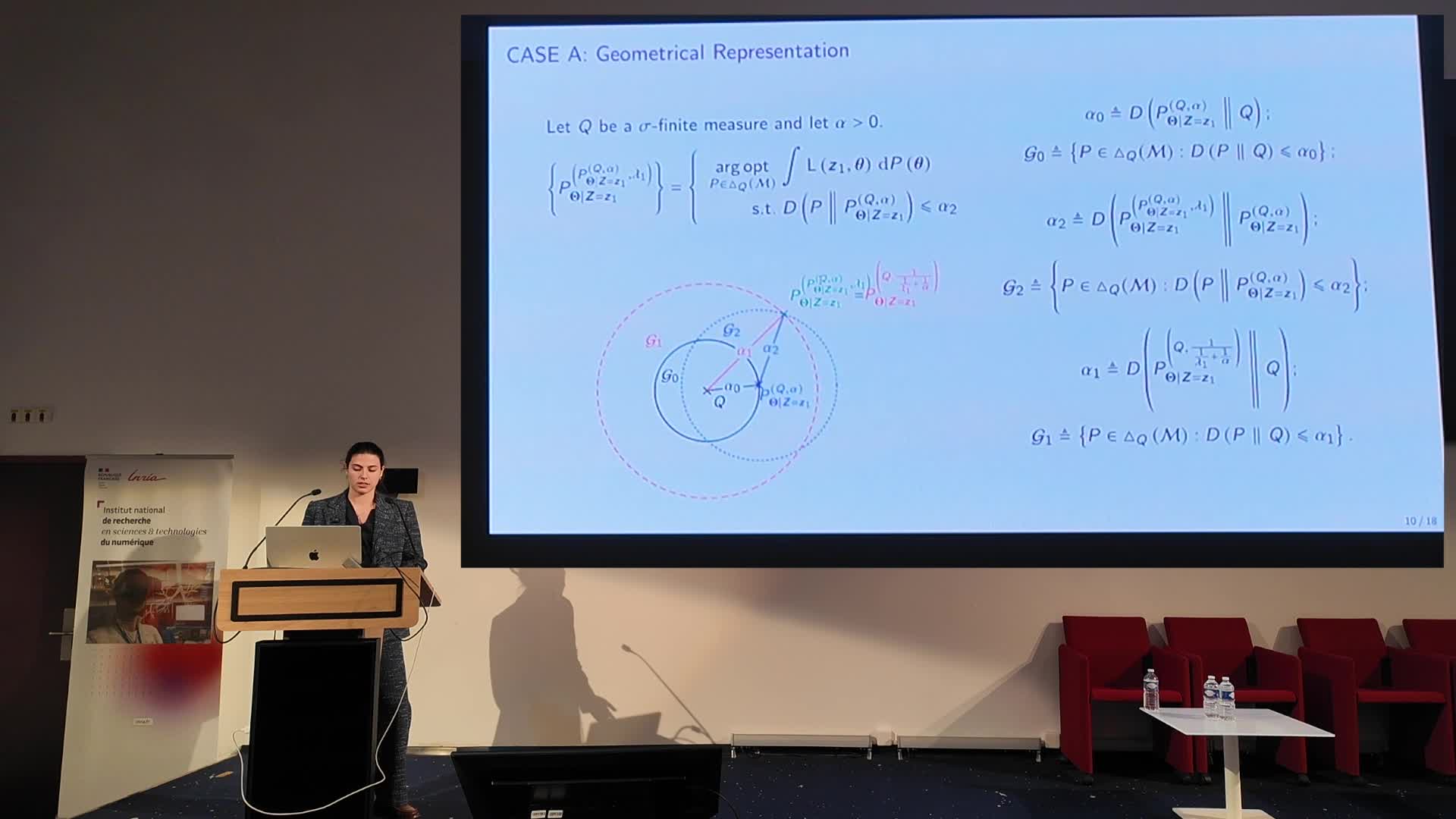
The lecture is composed of two parts. In the first one, I will present a novel framework for studying the generalization error of statistical learning algorithms, through the lens of a variable-size compressibility of algorithms. In this framework, the generalization error of an algorithm is linked to a variable-size 'compression rate’ of its input data. This is shown to yield bounds that depend on the empirical measure of the given input data at hand, rather than its unknown distribution. Moreover, it is shown that these general bounds subsume and possibly improve over several existing PAC-Bayes and data-dependent intrinsic dimension-based bounds that are recovered as special cases, thus unveiling a unifying character of our approach. For instance, a new data-dependent intrinsic dimension-based bound is established, which connects the generalization error to the optimization trajectories and reveals various interesting connections with the rate-distortion dimension of a process, the Rényi information dimension of a process and the metric mean dimension. The second part revolves around the important question of the relationship between generalization and data memorization in machine learning, which is yet to be fully understood. Indeed, the intuition that good algorithms should only extract relevant information and discard all irrelevant ones, which is also supported by some theoretic works, is challenged by the enormous success of modern overparametrized deep neural networks. I will be showing how suitable usage of the presented compressibility framework of the first part leads to bounds that are non-vacuous for certain instances problems for which classic MI and CMI bounds fail; and allows to characterize whether memorization is necessary for generalization for certain instance problems as was recently claimed. If time permits, I will also discuss various other implications, in particular on sample-compression schemes, fingerprinting codes and privacy attacks.
Sur le même thème
-
-
Machine Learning Regularization via Information Measures
Iñaki EsnaolaL’effet de l’asymétrie de l’entropie relative est analysé dans le contexte de la minimisation du risque empirique (ERM) avec régularisation par entropie relative (ERM-RER).
-
Sémiweb - Hub éducatif, LMS, amphipédia : repenser les espaces d’apprentissage
PerlotOlivierHub éducatif, LMS, amphipédia : repenser les espaces d’apprentissage
-
Minimization and Maximization of Empirical Risks: Applications in Data Unlearning and Decentralized…
BermudezYaizaCette présentation propose une nouvelle perspective sur la minimisation et la maximisation des risques empiriques avec régularisation par entropie relative en apprentissage statistique.
-
Le jeu comme support de communication
GouxMathieuCours de culture numérique dans le cadre de la licence humanité
-
What is the Long-Run Distribution of Stochastic Gradient Descent?
MertikopoulosPanayotisCette conférence explique le comportement à long terme de la descente de gradient stochastique, en montrant qu’elle tend à se concentrer autour des points critiques de basse énergie d’une manière
-
Rethinking Generalisation: Beyond KL with Geometry and Comparators
GuedjBenjaminIntervention sur la généralisation en apprentissage automatique, les avancées récentes de la théorie PAC-bayésienne, l’usage des distances de Wasserstein, les cadres généraux de comparateurs, ainsi
-
L'IA pour contrer l'IA : détection de citations peu fiables dans les articles scientifiques
CuxacPascalPascal Cuxac (INIST / CNRS) présente ici un outil basé sur l'IA afin de détecter des contenus créés par de l'IA dans les articles scientifiques.
-
Semiweb - La sobriété numérique : une urgence pédagogique
DescampsSarahLa sobriété numérique : une urgence pédagogique
-
24-25 Cours de culture numérique | Conférence culture numérique sur l'ia
ZimmermannAlbrechtCours de culture numérique dans le cadre la licence humanité
-
Semiweb - De l’accessibilité physique à l’accessibilité pédagogique
PlaisanceÉricDe l’accessibilité physique à l’accessibilité pédagogique : vers un renouvellement des problématiques et des pratiques ?
-
Semiweb - Sobriété numérique : les clés pour comprendre et agir
BordageFrédéricLe numérique est un 7ème continent en termes d’impacts environnementaux. Il représente déjà 40% de notre budget annuel soutenable. Pour la planète comme pour nos cerveaux surchargés, il est urgent de