Notice

#5-Climate Change effect on forests : A plant hydraulic perspective of issues and solutions
- document 1 document 2 document 3
- niveau 1 niveau 2 niveau 3
Descriptif
Abstract
Forests are at the cross road of multiple socio-ecological stakes including energy and material autonomy, carbon sequestration, biodiversity conservation whilst at the same time they are deeply impaired by climate change. In particular, increasing atmospheric and soil drought are responsible for an increasing trend in tree mortality, forest disturbances (diebacks, pathogen attacks and wildfires). The field of plant hydraulic offers a conceptual and formal basis to quantify climate impacts on trees physiology, derive consequences on forest disturbances and assess possible solutions for adaptation. In this talk, I will present how plant hydraulic measurements can be combined with the recent plant hydraulic model SurEau, to help anticipate global changes outcome on forests and evaluate solutions for forest adaptation.
>> Next seminar on August 26th by Eduardo Cappa, INTA, Argentina
Dans la même collection
-
#9 Extreme droughts, forest decline and mortality in the Patagonian Andes
SEMINAR # 9 : "Extreme droughts, forest decline and mortality in the Patagonian Andes" Ricardo Villalba (IANIGLA-CONICET, Mendoza, Argentina)
-
#8 : "Genomic selection for reaction norms on climatic indexes in maritime pine"
Sanchez RodriguezLeopoldoSEMINAR # 8 : "Genomic selection for reaction norms on climatic indexes in maritime pine" Léopoldo Sanchez-Rodriguez (INRAE, BioForA, France)
-
#7 « How to make trees talk about their frost resistance? »
CharrierGuillaumeAméglioThierrySEMINAR # 7 : « How to make trees talk about their frost resistance? » Guillaume Charrier (Speaker) and Thierry Ameglio, INRAE, UMR PIAF, France
-
#6 INTEGRATING QUANTITATIVE GENETICS AND GENOMICS WITH FOCUS ON IMPROVING PRODUCTIVITY AND CLIMATE-…
Dr. Eduardo Pablo Cappa, INTA, Argentina SEMINAR # 6 "INTEGRATING QUANTITATIVE GENETICS AND GENOMICS WITH FOCUS ON IMPROVING PRODUCTIVITY AND CLIMATE-ADAPTABILITY TRAITS IN TWO BOREAL CONIFER
-
#2 CLASSIC HYBRID BREEDING PROGRAM FOR P. ELLIOTTII VAR. ELLIOTTII X P. CARIBAEA VAR. HONDURENSIS I…
Gauchat Funes DrewesMaría ElenaRound of FORESTIA web seminars SEMINAR # 2 "Classic Hybrid Breeding Program for P. elliottii var. elliottii x P. caribaea var. hondurensis in the Northeast of Argentina" María Elena Gauchat,
-
#3 CLIMATE CHANGE EFFECTS ON FOREST ECOSYSTEMS IN THE LIGHT OF INTERACTIONS BETWEEN TREES AND PHYTO…
BoivinThomasRound of FORESTIA web seminars SEMINAR # 3 "Climate change effects on forest ecosystems in the light of interactions between trees and phytophagous insects" Thomas Boivin, INRAE, France May 13
-
#1 "How climate change is challenging forest research" - Pr. Philippe Rozenberg
RozenbergPhilippeLia forestia 2022 Webinaire 1 du 25 mars 2022 par Philippe Rozenberg (INRAE, France) "How climate change is challenging forest research"


Sur le même thème
-
Une année au Muséum national d'histoire naturelle de Paris : retour d'expérience sur une résidence …
DodartGustaveGustave Dodart a été wikimédien en résidence au Muséum d'Histoire Naturelle de Paris durant un an. Il présente dans cette vidéo son travail et ses réalisations.
-
Des valeurs de la biodiversité à la justice environnementale : un regard philosophique sur la trans…
BeauRémiAprès avoir proposé un état de l’art des recherches sur les valeurs de la biodiversité en éthique environnementale, Rémi Beau mettra ces différentes approches en dialogue avec leurs possibles
-
Regards croisés sur les transitions agroécologiques et alimentaires
VialatteAudeFerhoutHichamChâteau TerrissePascaleGibertCarolineCoulonFrédéricRegards croisés sur les transitions agroécologiques et alimentaires
-
Présentation générale du portail InDoRES
Cette vidéo vous explique comment s'organise le projet InDoRES, son site et les outils mis à disposition de la communauté scientifique.
-
Interview de Bernard Hubert (Écologue à l'INRAE)
HubertBernardInterview de Bernard Hubert (Écologue à l'INRAE)
-
Journée de lancement PEPR Dynabiod - Matinée
BlochGillesSchuhlAlainHuetBriceBorelCorinnePersozCharlesLarigauderieAnnePorcherEmmanuelleRougerieRodolpheThuillerWilfriedRetransmission de la matinée de lancement du PEPR Dynabiod
-
Dynabiod : Entretien avec Emmanuelle Porcher, Wilfried Thuiller et Rodolphe Rougerie
RougerieRodolpheThuillerWilfriedPorcherEmmanuellePrésentation de Dynabiod par Emmanuelle Porcher, Wilfried Thuiller et Rodolphe Rougerie, les co-directeurs scientifiques du programme. 🎥 © MNHN - S. Pagani 📷 Illustrations : Sensory Odyssey, Paul
-
Quand elles arrivent en ville
PodevinSophieDefranceJérémyDes binômes, composés d’un·e scientifique et d’un·e réalisateur·rice, ont 48h pour écrire, tourner et monter un court métrage ensemble sur le sujet de recherche du/de la scientifique. Les participant
-
Fertiliser à l'urine, vers une gestion artisanale et circulaire des nutriments
BrunFlorentUtiliser les urines et les matières fécales en agriculture ? L'idée n'a rien de nouveau ! Face au dépassement des limites planétaires, la recherche d'alternatives renouvelables devient essentielle,
-
Livestock farming: source of biodiversity - Q/A
DumontBertrandLemauviel-LavenantServaneMartelGilles[Grazing livestock] Sequence 15. Livestock farming: source of biodiversity
-
Parc Urbain des Papillons (Marseille)
CarréMagueloneChatrieLauraLe Parc Urbain des Papillons (PUP) est un site expérimental unique dédié à la biodiversité urbaine à Marseille
-
Nourrir l’Europe en 2050
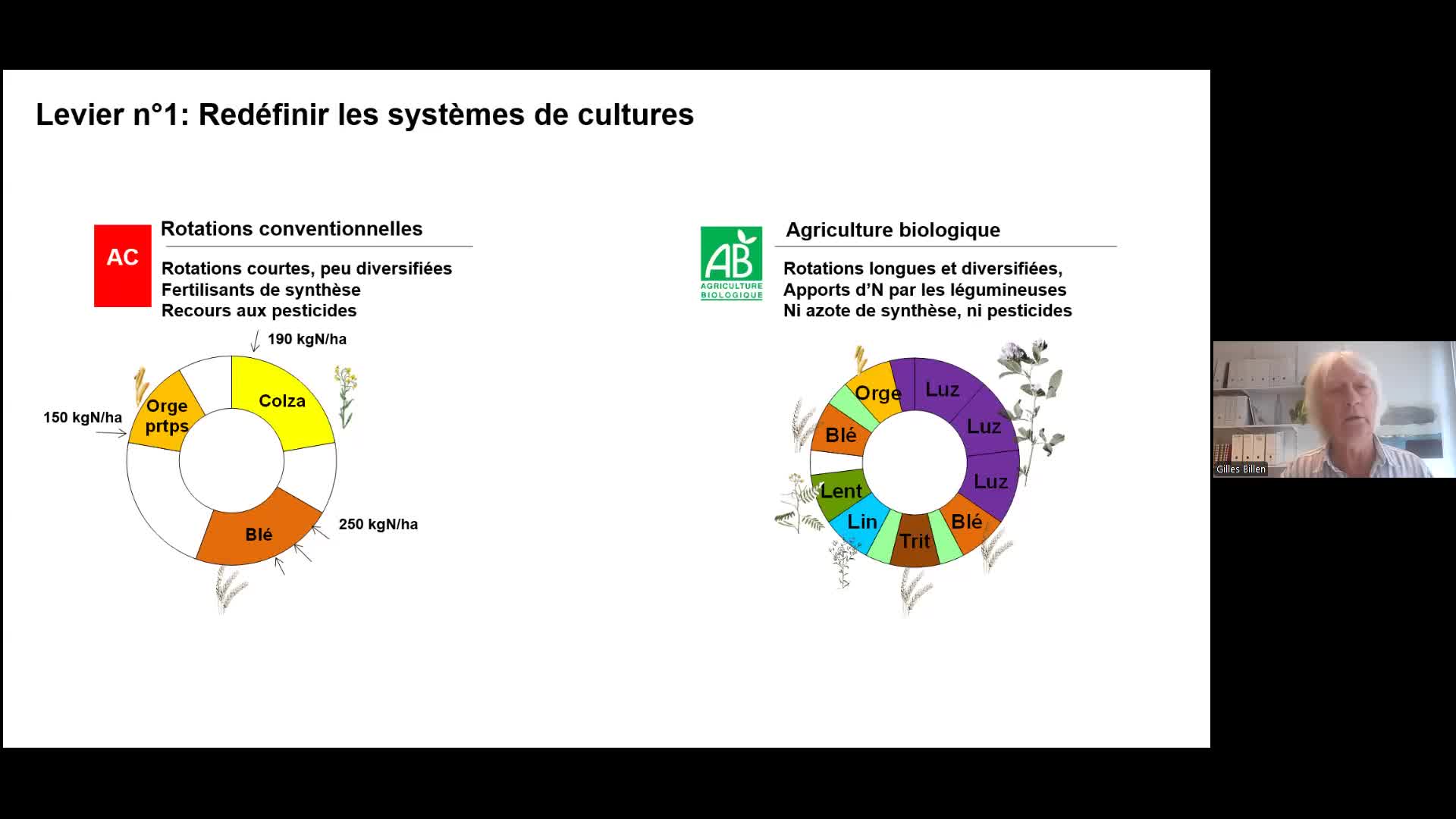
BillenGillesDans le cadre de la semaine européenne du développement durable (SEED), le service responsabilité sociale de l’employeur a proposé le webinaire « Nourrir l’Europe en 2050 avec une alimentation durable