

Notice

Embodied minds
- document 1 document 2 document 3
- niveau 1 niveau 2 niveau 3
Descriptif
Interacting minds: combining art and science to explore the social, dynamic, and embodied nature of human cognition
In this series of three seminars, we will discuss the view of "extended cognition", or how to bring social interactions, the dynamic feedback loops between us and our environments, and our bodies into the study of the mind. Particular focus will be in how the cross-exposure from art and science can reveal phenomena about our minds, sociality and interactions that would be impossible for either to reach alone.
We will look at "improvised interactions" in music, dance, and decision-making, peruse literature from neuroscience, social psychology, cognitive science and philosophy, and see how recent scientific advances (both theoretical and methodological) have changed our view of how the mind works, and form ideas of how we should study it. We will exchange experiences and ideas about how to best combine artistic and scientific practices and ideas.
Seminar 1: Social minds (2.11.)
What does it mean if we see sociality as the "default mode" of humans interacting with their environment and not as the top end of a tall ladder of elementary, individual functions? How are art and empathy linked?
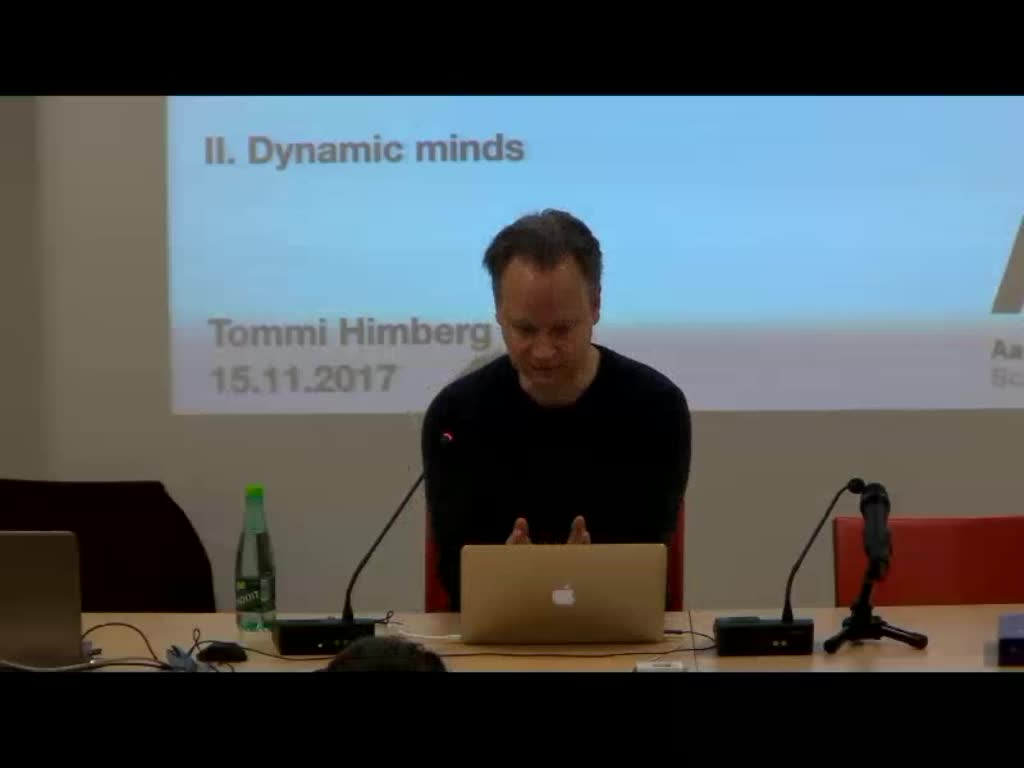
Seminar 2: Dynamic minds (15.11.)
Statics of the dynamic mind: what changes if we look at the social minds in motion? In psychology and neuroscience we talk of states, e.g. "emotional states", or measure behaviours in trials where we assume the behaviour to switch on at the beginning and continue until the beep at the end. Performing arts know better: being static is a statement; it is not natural; it might even be dead.
Seminar 3: Embodied minds (22.11.)
One of the first extensions to cognitive science was the embodied approach: the mind/brain is a part of a body, and the body is not only for carrying the brain around. But embodiment often seems like a popular but empty buzzword; having learned so much about the mind since the inception of embodied cognition, what should embodied cognition 2.0 look like?
Intervention / Responsable scientifique
Dans la même collection
-
Dynamic minds
HimbergTommiInteracting minds: combining art and science to explore the social, dynamic, and embodied nature of human cognition In this series of three seminars, we will discuss the view of "extended
-
Social Minds
HimbergTommiInteracting minds: combining art and science to explore the social, dynamic, and embodied nature of human cognition

Avec les mêmes intervenants et intervenantes
-
Dynamic minds
HimbergTommiInteracting minds: combining art and science to explore the social, dynamic, and embodied nature of human cognition In this series of three seminars, we will discuss the view of "extended
-
Social Minds
HimbergTommiInteracting minds: combining art and science to explore the social, dynamic, and embodied nature of human cognition
-
ICI : De l'Improvisation Conjointe à l'Interaction
HimbergTommiBachrachAsafLutesClintFörgerKlausBigéEmmaEn savoir plus sur la journée En savoir plus sur ICI
Sur le même thème
-
The leaflet: a specialized domain of the astrocyte for multimodal coordination with synapses
Pernet-GallayKarinBy combining volumetric high-resolution electron microscopy and two-photon Ca2+ imaging, we characterize astrocyte leaflets that interface with synapses and highlight the role of astrocytes as
-
Investigating the role of spine architecture in calcium dynamics
RangamaniPadminiThe talk showcases Computational modeling of second messenger dynamics in dendritic spines.
-
The structural plasticity lurking beneath the connectome
ChirilloMichaelThis talk explores the ultrastructural mechanisms of synaptic plasticity in the hippocampus using serial section electron microscopy, from resource redistribution to the structural organization of
-
Volume EM Segmentation and Applications in Comparative Connectomics
PapeConstantinAutomated circuit reconstruction is a prerequisite for the analysis of connectomes.
-
Linking astrocyte nano-architecture and function: insights from computational tools
DenizotAudreyWe develop and share in open-access models, software, and 3D cell meshes to contribute to the global effort to elucidate the complex astrocyte structure-function relationship in health and disease
-
Mapping the neuronal circuits for smell with light, x-rays and electrons
BoschCarlesIntegrating physiology and structure at the neuronal circuit scale can provide a mechanistic understanding on how that circuit works.
-
Archétypes - Épisode 10 : La cheffe d'orchestre, Maureen Clerc
ClercMaureenPortrait de Maureen Clerc, directrice du centre Inria de l’Université Côte d’Azur et spécialiste des interfaces cerveau-machine.
-
Diplôme Universitaire - Apprendre à apprendre
Présentation de la formation
-
L'exploration mentale #4 – Intelligence émotionnelle et la compréhension de ses granularités
LacroixÉricPorlierChristopheL'exploration mentale #4 – Intelligence émotionnelle et compréhension de ses granularités
-
L'exploration mentale #3 – La visualisation dans la performance sportive
LacroixÉricPorlierChristopheL'exploration mentale #3 – La visualisation dans la performance sportive
-
Astrocyte nanoarchitecture and its disruption in an Alzheimer’s disease model
SalmonChrisSerial electron microscopy (EM) using Focussed Ion Beam Scanning EM (FIBSEM) allowed us to assess the 3D cellular organizing principles of astrocytes at unprecedented resolution in both healthy and
-
The coldness of the stone and the lightness of the bird: a memorial garden for the victims of Novem…
AccarainMadeleineTalk by Madeleine ACCARAIN (Wagon Landscaping, Paris), as part of the workshop "Memory, Place, and Material Culture", organized by John SUTTON, 2022-2023 research fellow at the Paris IAS, Emeritus


