Notice

1.8. Goppa Codes
- document 1 document 2 document 3
- niveau 1 niveau 2 niveau 3
Descriptif
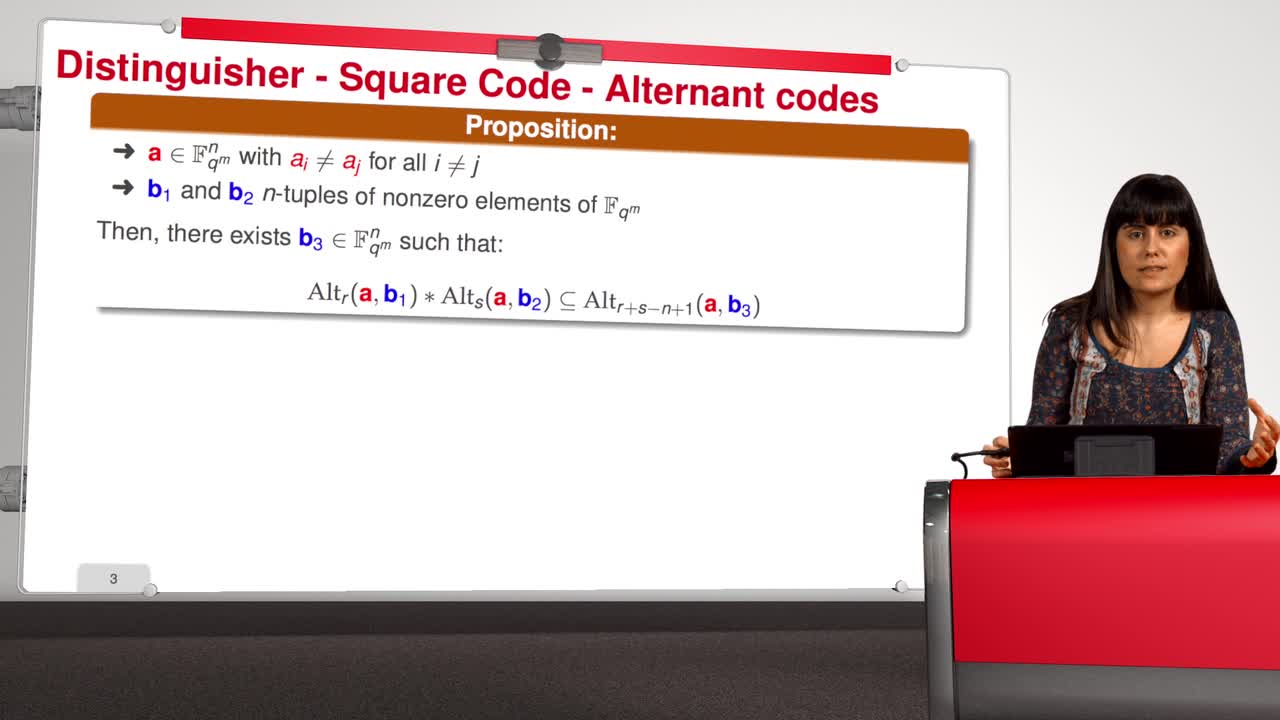
In this session, we willtalk about another family of codes that have an efficientdecoding algorithm: the Goppa codes. One limitation of thegeneralized Reed-Solomon codes is the fact that the length isbounded by the size of the field over which it is defined. This implies that these codes areuseful when we use a large field size. In the sequence, we'llpresent a method to obtain a new code over small alphabets byexploiting the properties of the generalized Reed-Solomon codes. So, the idea is to construct a generalizedReed-Solomon code over a sufficiently large extensionof a field and extract only those codewords that liecompletely in the field. Let a be a n-tuple ofelements from the field Fq^n which are all differentand let b be an n-tuple of elements from the field Fq^n which are non-zeros. Then, the alternant codesassociated to the pair a,b and parameter r is the Fqlinear restriction of the generalized Reed-Solomon codes ofdimension r associated to the pair a,b. a will be called the supportand b the column multiplier. So, the alternant code associated to the parameters a and b isa linear code with dimension greater than n - mr andminimum distance greater than r + 1 And the proof is very easy. First of all, recall thatthe dual of a generalized Reed-Solomon code is again ageneralized Reed-Solomon code.
And this new generalizedReed-Solomon code has parameters n, n - r and r + 1 since the generalized Reed-Solomon code is MDS. Thus, the alternant codeassociated to the pair a and b can be defined by r paritycheck equations over Fq^m and mr parity check equations over Fq. So, the dimension of thealternant code must be at least n - mr. Moreover, theminimum distance of an alternant code is at least theminimum distance of a generalized Reed-Solomon code since thegeneralized Reed-Solomon code is a subset of the alternant code.
Intervention / Responsable scientifique


Dans la même collection
-
5.2. The Courtois-Finiasz-Sendrier (CFS) Construction
Marquez-CorbellaIreneSendrierNicolasFiniaszMatthieuIn this session, I am going to present the Courtois-Finiasz-Sendrier Construction of a code-based digital signature. In the previous session, we have seen that it is impossible to hash a document
-
4.6. Attack against GRS codes
Marquez-CorbellaIreneSendrierNicolasFiniaszMatthieuIn this session we will discuss the proposal of using generalized Reed-Solomon codes for the McEliece cryptosystem. As we have already said, generalized Reed-Solomon codes were proposed in 1986 by
-
5.5. Stern’s Zero-Knowledge Identification Scheme
Marquez-CorbellaIreneSendrierNicolasFiniaszMatthieuIn this session, we are going to have a look at Stern’s Zero-Knowledge Identification Scheme. So, what is a Zero-Knowledge Identification Scheme? An identification scheme allows a prover to prove
-
4.9. Goppa codes still resist
Marquez-CorbellaIreneSendrierNicolasFiniaszMatthieuAll the results that we have seen this week doesn't mean that code based cryptography is broken. So in this session we will see that Goppa code still resists to all these attacks. So recall that
-
4.4. Attack against subcodes of GRS codes
Marquez-CorbellaIreneSendrierNicolasFiniaszMatthieuIn this session, we will talk about using subcodes of a Generalized Reed–Solomon code for the McEliece Cryptosystem. Recall that to avoid the attack of Sidelnikov and Shestakov, Berger and
-
5.3. Attacks against the CFS Scheme
Marquez-CorbellaIreneSendrierNicolasFiniaszMatthieuIn this session, we will have a look at the attacks against the CFS signature scheme. As for public-key encryption, there are two kinds of attacks against signature schemes. First kind of attack is
-
4.7. Attack against Reed-Muller codes
Marquez-CorbellaIreneSendrierNicolasFiniaszMatthieuIn this session, we will introduce an attack against binary Reed-Muller codes. Reed-Muller codes were introduced by Muller in 1954 and, later, Reed provided the first efficient decoding algorithm
-
5.6. An Efficient Provably Secure One-Way Function
Marquez-CorbellaIreneSendrierNicolasFiniaszMatthieuIn this session, we are going to see how to build an efficient provably secure one-way function from coding theory. As you know, a one-way function is a function which is simple to evaluate and
-
5.1. Code-Based Digital Signatures
Marquez-CorbellaIreneSendrierNicolasFiniaszMatthieuWelcome to the last week of this MOOC on code-based cryptography. This week, we will be discussing other cryptographic constructions relying on coding theory. We have seen how to do public key
-
4.5. Error-Correcting Pairs
Marquez-CorbellaIreneSendrierNicolasFiniaszMatthieuWe present in this session a general decoding method for linear codes. And we will see it in an example. Let C be a generalized Reed-Solomon code of dimension k associated to the pair (c, d). Then,
-
5.4. Parallel-CFS
Marquez-CorbellaIreneSendrierNicolasFiniaszMatthieuIn this session, I will present a variant of the CFS signature scheme called parallel-CFS. We start from a simple question: what happens if you try to use two different hash functions and compute
-
4.8. Attack against Algebraic Geometry codes
Marquez-CorbellaIreneSendrierNicolasFiniaszMatthieuIn this session, we will present an attack against Algebraic Geometry codes (AG codes). Algebraic Geometry codes is determined by a triple. First of all, an algebraic curve of genus g, then a n

Avec les mêmes intervenants et intervenantes
-
5.2. The Courtois-Finiasz-Sendrier (CFS) Construction
Marquez-CorbellaIreneSendrierNicolasFiniaszMatthieuIn this session, I am going to present the Courtois-Finiasz-Sendrier Construction of a code-based digital signature. In the previous session, we have seen that it is impossible to hash a document
-
4.6. Attack against GRS codes
Marquez-CorbellaIreneSendrierNicolasFiniaszMatthieuIn this session we will discuss the proposal of using generalized Reed-Solomon codes for the McEliece cryptosystem. As we have already said, generalized Reed-Solomon codes were proposed in 1986 by
-
5.5. Stern’s Zero-Knowledge Identification Scheme
Marquez-CorbellaIreneSendrierNicolasFiniaszMatthieuIn this session, we are going to have a look at Stern’s Zero-Knowledge Identification Scheme. So, what is a Zero-Knowledge Identification Scheme? An identification scheme allows a prover to prove
-
4.9. Goppa codes still resist
Marquez-CorbellaIreneSendrierNicolasFiniaszMatthieuAll the results that we have seen this week doesn't mean that code based cryptography is broken. So in this session we will see that Goppa code still resists to all these attacks. So recall that
-
4.4. Attack against subcodes of GRS codes
Marquez-CorbellaIreneSendrierNicolasFiniaszMatthieuIn this session, we will talk about using subcodes of a Generalized Reed–Solomon code for the McEliece Cryptosystem. Recall that to avoid the attack of Sidelnikov and Shestakov, Berger and
-
5.3. Attacks against the CFS Scheme
Marquez-CorbellaIreneSendrierNicolasFiniaszMatthieuIn this session, we will have a look at the attacks against the CFS signature scheme. As for public-key encryption, there are two kinds of attacks against signature schemes. First kind of attack is
-
4.7. Attack against Reed-Muller codes
Marquez-CorbellaIreneSendrierNicolasFiniaszMatthieuIn this session, we will introduce an attack against binary Reed-Muller codes. Reed-Muller codes were introduced by Muller in 1954 and, later, Reed provided the first efficient decoding algorithm
-
5.6. An Efficient Provably Secure One-Way Function
Marquez-CorbellaIreneSendrierNicolasFiniaszMatthieuIn this session, we are going to see how to build an efficient provably secure one-way function from coding theory. As you know, a one-way function is a function which is simple to evaluate and
-
5.1. Code-Based Digital Signatures
Marquez-CorbellaIreneSendrierNicolasFiniaszMatthieuWelcome to the last week of this MOOC on code-based cryptography. This week, we will be discussing other cryptographic constructions relying on coding theory. We have seen how to do public key
-
4.5. Error-Correcting Pairs
Marquez-CorbellaIreneSendrierNicolasFiniaszMatthieuWe present in this session a general decoding method for linear codes. And we will see it in an example. Let C be a generalized Reed-Solomon code of dimension k associated to the pair (c, d). Then,
-
5.4. Parallel-CFS
Marquez-CorbellaIreneSendrierNicolasFiniaszMatthieuIn this session, I will present a variant of the CFS signature scheme called parallel-CFS. We start from a simple question: what happens if you try to use two different hash functions and compute
-
4.8. Attack against Algebraic Geometry codes
Marquez-CorbellaIreneSendrierNicolasFiniaszMatthieuIn this session, we will present an attack against Algebraic Geometry codes (AG codes). Algebraic Geometry codes is determined by a triple. First of all, an algebraic curve of genus g, then a n
Sur le même thème
-
Données numériques de recherche et traitement calculatoire
BachimontBrunoLes chercheur·ses en SHS et les politiques de partage des données de la recherche en France
-
Archétypes - Épisode 8 : La magicienne, Nathalie Revol
RevolNathaliePortrait de Nathalie Revol, chercheuse en mathématiques numériques à Inria Lyon (équipe PASCALINE), spécialisée dans le calcul de haute précision et la fiabilité des simulations numériques.
-
La cryptologie, d’hier, d’aujourd’hui et de demain
PierrotCécileLa science des codes secrets n’a cessé d’influencer le cours de l’histoire.
-
La meilleure défense, c’est l’attaque : pourquoi et comment casser des systèmes cryptographiques ?
CanteautAnneLes procédés de chiffrement sont des versions modernes et élaborées de ces fameux « codes secrets », qui fascinent tant par leur côté ludique que par le rôle qu’ils ont parfois joué dans l’histoire.
-
Machine Learning Regularization via Information Measures
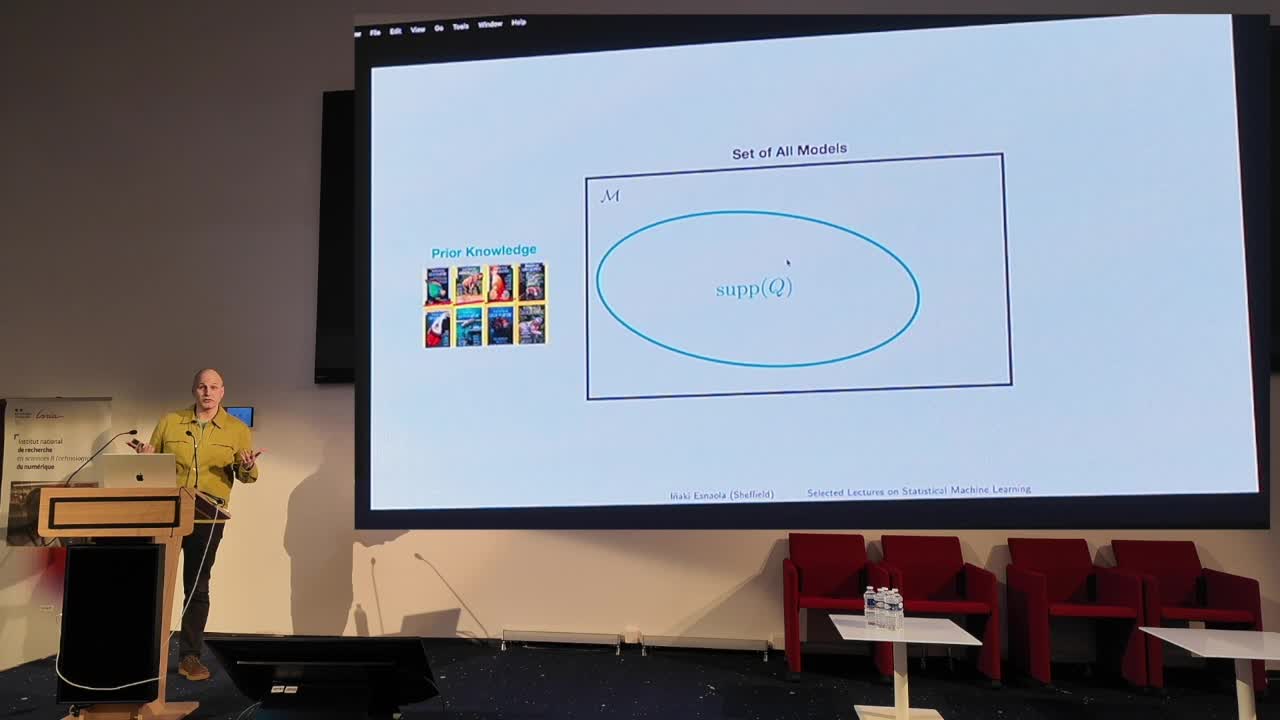
Iñaki EsnaolaL’effet de l’asymétrie de l’entropie relative est analysé dans le contexte de la minimisation du risque empirique (ERM) avec régularisation par entropie relative (ERM-RER).
-
Minimization and Maximization of Empirical Risks: Applications in Data Unlearning and Decentralized…
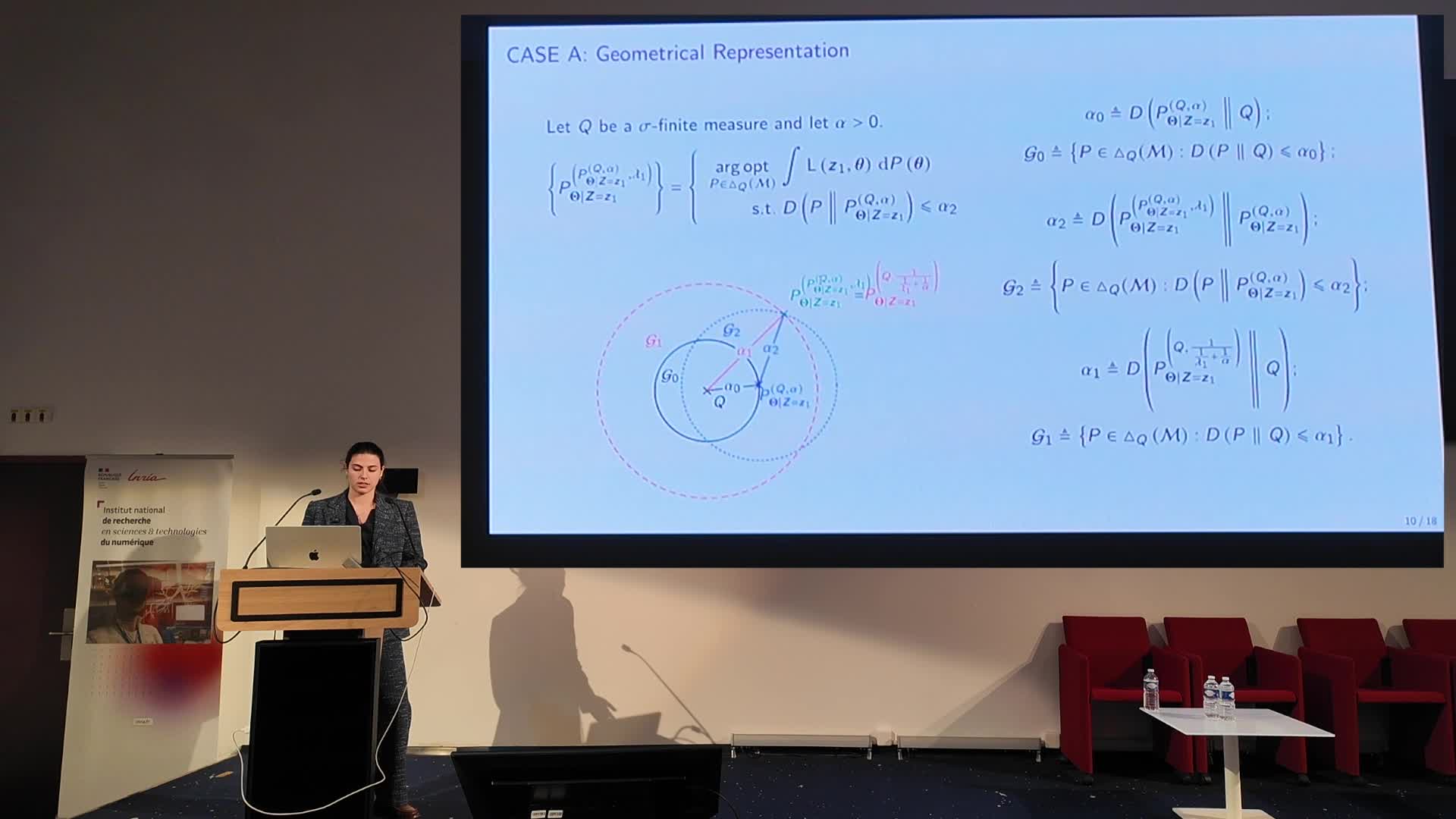
BermudezYaizaCette présentation propose une nouvelle perspective sur la minimisation et la maximisation des risques empiriques avec régularisation par entropie relative en apprentissage statistique.
-
A Compressibility Approach to Generalization and (No) Memorization
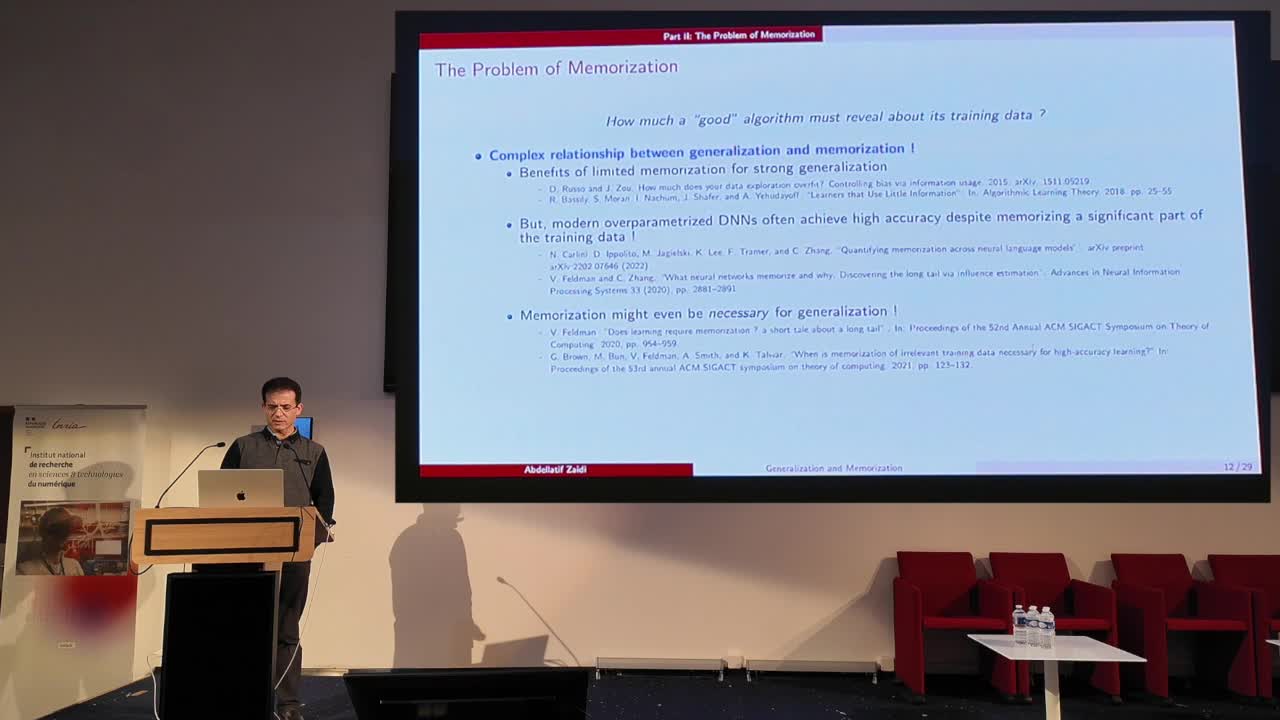
ZaidiAbdellatifUne conférence sur l’approche par la compressibilité pour comprendre la généralisation et la non-mémorisation.
-
Rethinking Generalisation: Beyond KL with Geometry and Comparators
GuedjBenjaminIntervention sur la généralisation en apprentissage automatique, les avancées récentes de la théorie PAC-bayésienne, l’usage des distances de Wasserstein, les cadres généraux de comparateurs, ainsi
-
What is the Long-Run Distribution of Stochastic Gradient Descent?
MertikopoulosPanayotisCette conférence explique le comportement à long terme de la descente de gradient stochastique, en montrant qu’elle tend à se concentrer autour des points critiques de basse énergie d’une manière
-
Tuan Ta Pesao : écritures de sable et de ficelle à l'Ile d'Ambrym
VandendriesscheEricEtulCamilleCe film se déroule au Nord de l’île d’Ambrym, dans l’archipel de Vanuatu, en Mélanésie...
-
FOUNDS Seminar Series Talk 12 - Decision making via End-to-End Lossy Distributed Wireless Networks
Talk Title : Decision making via End-to-End Lossy Distributed Wireless Networks: A Distributed Hypothesis Testing based Formulation Abstract : The goal of this seminar is to provide the
-
FOUNDS Seminar Series Talk 11 - Stochastic Geometry and Queuing Dynamics
BaccelliFrançoisSeminar Title : Stochastic Geometry and Queuing Dynamics in Large Wireless Networks